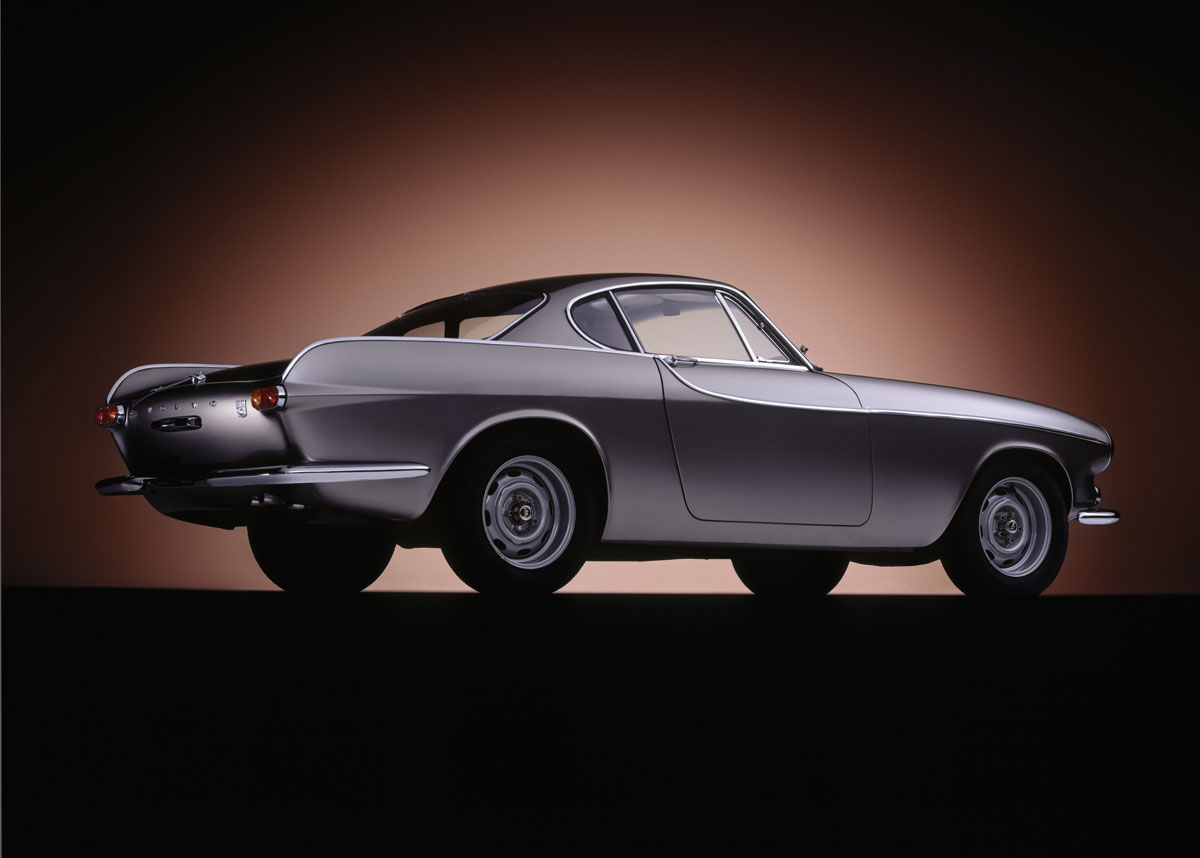

History
The project was started in 1957 because Volvo wanted a sports car, despite the fact that their previous attempt, the P1900, had been a disaster, with only 68 cars sold. The man behind the project was an engineering consultant to Volvo, Helmer Pettersson, who in the 1940s was responsible for the Volvo PV444. The design work was done by Helmer's son Pelle Pettersson, who worked at Pietro Frua at that time. Volvo insisted it was an Italian design by Frua and only officially recognized that Pelle Pettersson designed it in 2009. The Italian Carrozzeria Pietro Frua design firm (then a recently acquired subsidiary of Ghia) built the first three prototypes, designated: P958-X1, P958-X2 and P958-X3.In December 1957 Helmer Petterson drove X1, (the first hand-built P1800 prototype) to Osnabrück, West Germany, headquarters of Karmann. Petterson hoped that Karmann would be able to take on the tooling and building of the P1800. Karmann's engineers had already been preparing working drawings from the wooden styling buck at Frua. Petterson and Volvo chief engineer Thor Berthelius met there, tested the car and discussed the construction with Karmann. They were ready to build it and this meant that the first cars could hit the market as early as December 1958. But in February, Karmann's most important customer, Volkswagen AG, forbade Karmann to take on the job.They were afraid that the P1800 would compete with the sales of their own cars, and threatened to cancel all their contracts with Karmann if they took on the coachbuilding of this car. This setback almost caused the project to be abandoned.
Other German firms NSU, Drautz and Hanomag were contacted but none of them were selected because Volvo did not believe these firms met their manufacturing quality control standards.
It began to appear that Volvo might never produce the P1800. This motivated Helmer Petterson to obtain financial backing from two financial firms with the intention of buying the components directly from Volvo, and marketing the car himself. At this point Volvo had made no mention of the P1800 and the factory would not comment. Then a press release surfaced with a photo of the car, putting Volvo in a position where they had to acknowledge the car's existence. These events influenced the company to renew its efforts, the car was presented to the public for the first time at the Brussels Motor Show in January 1960 and Volvo turned to Jensen Motors whose production lines were under capacity, and they agreed to a contract of 10,000 cars.The Linwood, Scotland, body plant of manufacturer Pressed Steel was in turn contracted by Jensen to create the unibody shell, which then shipped via rail to be assembled at Jensen in West Bromwich, England. In September 1960, the first production P1800 (for the 1961 model year) left Jensen for an eager public.
P1800The engine provided was the B18 (B for the Swedish word for gasoline: Bensin; 18 for 1800 cc displacement) with dual SU carburettors, producing 100 hp (75 kW). This variant (named B18B) had a different camshaft from, and higher compression than, the slightly less powerful twin-carb B18D used in the contemporary Amazon 122S. The 'new' B18 was actually developed from the pre-existing B36 V8 engine employed in Volvo trucks at the time. This cut production costs, as well as furnishing the P1800 with a strong engine boasting five main crankshaft bearings. The B18 was matched with the new and more robust M40 manual gearbox through 1963. From 1963 to 1972 the M41 gearbox with electrically actuated overdrive was a popular option. Two overdrive types were used, the D-Type through 1969, and the J-type through 1973. The J-type had a slightly shorter ratio of 0.797:1 as opposed to 0.756:1 for the D-type. The addition of this overdrive gave the 1800 series a defacto fifth gear, allowing it greater fuel efficiency and decreased drivetrain wear. Cars sold without overdrive had a numerically lower geared differential, which had the interesting effect of giving them a somewhat higher top speed (just under 120 mph) than the more popular overdrive models. This was because the non-overdrive cars could reach the engine's redline in top gear, while the overdrive-equipped cars could not, giving the latter a top speed of roughly 110 mph (177 km/h).
1800SAs time progressed, Jensen had problems with quality control, so the contract was ended early at 6,000 cars. In 1963 production was moved to Volvo's Lundby Plant in Gothenburg and the car's name was changed to 1800S (the 'S' indicating Swedish assembly). The engine was improved with an additional 8 hp (6 kW). In 1966 the four-cylinder engine was updated to 115 hp (86 kW). Top speed was 175 km/h (109 mph). In 1969 the B18 engine was replaced with the 2-liter B20B variant of the B20 giving 118 bhp (89 kW), though it kept the designation 1800S.
1800EFor 1970 numerous changes came with the fuel-injected 1800E, which had the B20E engine with Bosch D-Jetronic fuel injection and a revised camshaft and produced 130 bhp (97 kW) from its 2-litres without sacrificing fuel economy. Top speed was around 190 km/h (just under 120 mph) and acceleration from 0–100 km/h (0-62.1 mph) was 9.5 seconds. In addition, the 1970 model was the first 1800 to appear with four-wheel disc brakes. Prior to this, the 1800 series had front discs and rear drums.
1800ESIn 1972 came the last model, the 1800ES, a coupé station wagon or what the British would call a shooting-brake version with an all-glass tailgate. The final design was chosen after two prototypes had been built by Coggiola and Pietro Frua. Frua's very unusual looking prototype,Raketen ("the Rocket", on the right), currently resides in the Volvo Museum. Both of the Italian prototypes were considered too futuristic, and instead in-house designer Jan Wilsgaard's proposal was accepted. The ES engine was downgraded to 125 bhp (92 kW) by reducing the compression ratio with a thicker head gasket (engine variant B20F); although maximum power was slightly down the engine was less "peaky" and the real-world performance was actually improved.
P1800ES
P1800ES
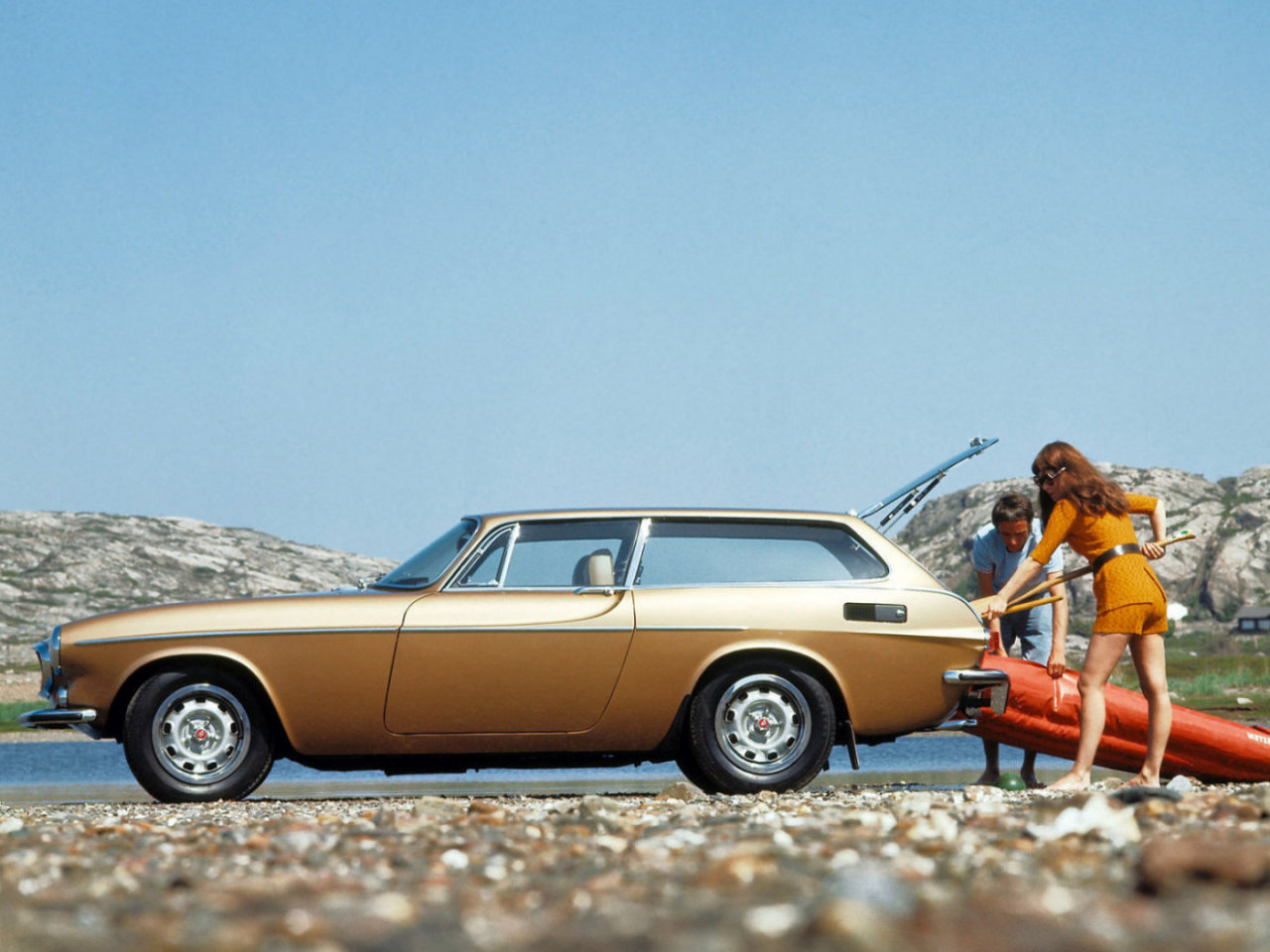
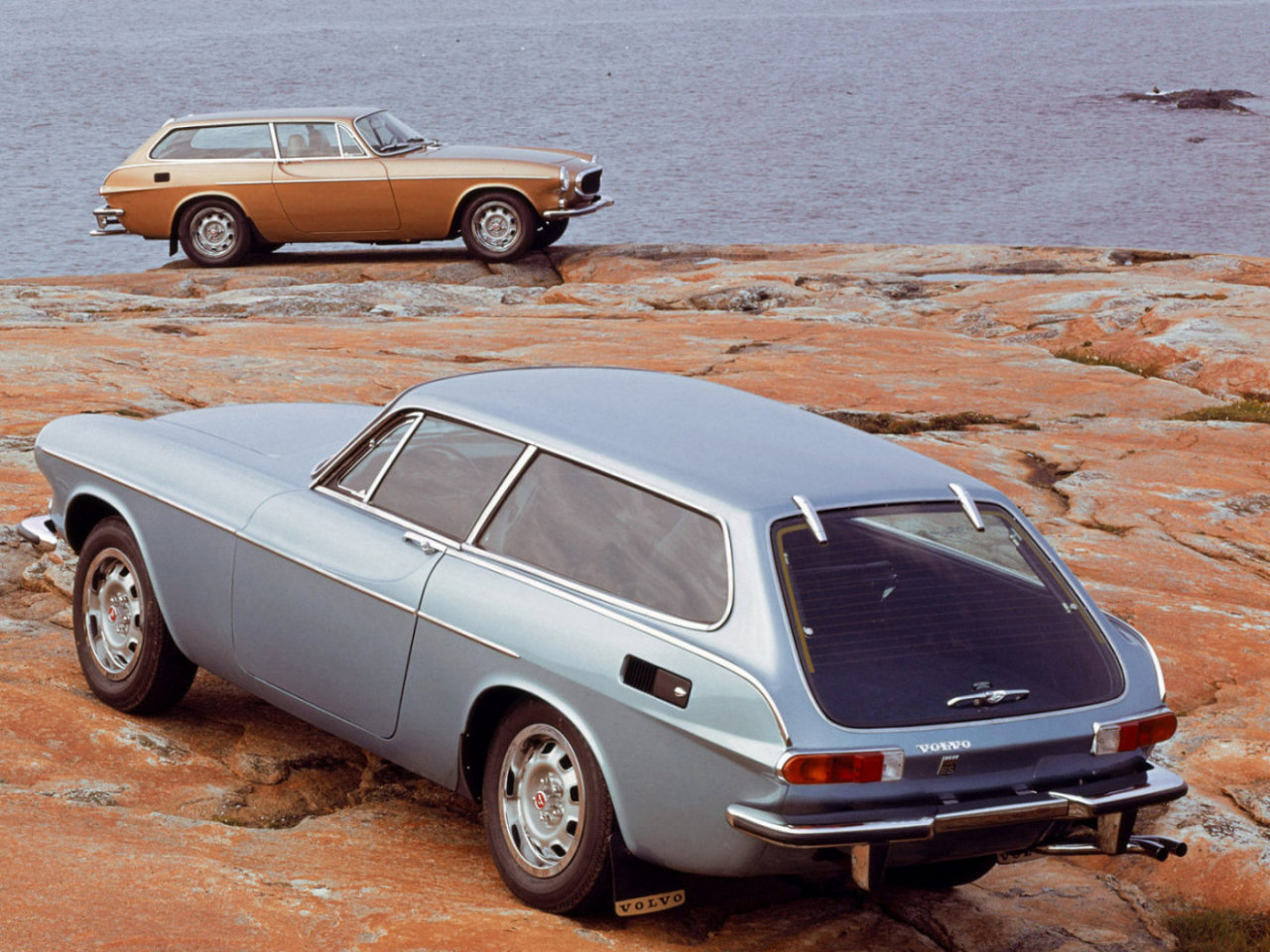

The ESs rear backrest folded down to create a long flat loading area. In addition to the usual four-speed plus overdrive manual transmission, a Borg-Warner three-speed automatic was also available in the P1800ES. With stricter American safety and emissions standards looming for 1974, Volvo did not see fit to spend the considerable amount that would be necessary to redesign the small-volume P1800 ES. Only 8,077 of the ES were built in its two model years.
Volvo P1800 timeline
- 1959 – Volvo announces P1800 prototype built by Frua.
- 1960 – The car is showcased in Brussels, first pre-production cars tested.
- 1961 – Production car: 2-door coupe, steel body, 2+2 seating, 1.8-liter twin carburettor engine, 100 bhp/5,500 rpm. First 6,000 cars assembled in the UK by Jensen Motors.
- 1963 – P1800 is renamed 1800S to mark the start of Swedish assembly. Introduction of the 1964 model with improved 108 bhp engine, improved brakes and modified seats.
- 1964 – Revised interior, straight bumpers with rubber inserts.
- 1965 – Power increased to 115 bhp, diaphragm clutch, sealed greasing, improved brakes.
- 1966 – Modified front grille, chrome side trim introduced.
- 1967 – Three spoke steering wheel, minor interior changes.
- 1968 – 2.0-liter engine type B20, 118 bhp/5,800 rpm, fitted with emission equipment. Dual circuit braking system introduced.
- 1969 – 1800E model with Bosch electronic fuel injection developing 130 bhp at 6,000 rpm (B20E). ZF gearbox, disc brakes on all wheels, alloys, new dashboard.
- 1970 – Stronger Volvo-built manual gearbox or optional Borg-Warner 3 speed automatic introduced.
- 1971 – 1800ES estate car launched.
- 1972 – 112 bhp B20F engine USA-emissions compliant.
- 1973 – Production ends.
text: wikipedia
Volvo P1800, 1963 - Photography by René Staud
Volvo P1800 ES, 1972-73 - carstyling
Comments
Post a Comment