
World’s First Rear-Engine Carbon Monocoque Road Car
First RUF car engineered and designed by RUF
First rear-engine carbon fiber monocoque chassis
Twin-turbo 3.6L flat-six creates 522 kw (710 PS), 880 Nm (649 lb-ft)
Rear-engine design sends power to rear wheels through six-speed manual gear box
Top speed in excess of 360 km/h (223 mph)
0-100 km/h (62 mph) in less than 3.5 seconds, 0-200 km/h (124 mph) in less than 9
seconds
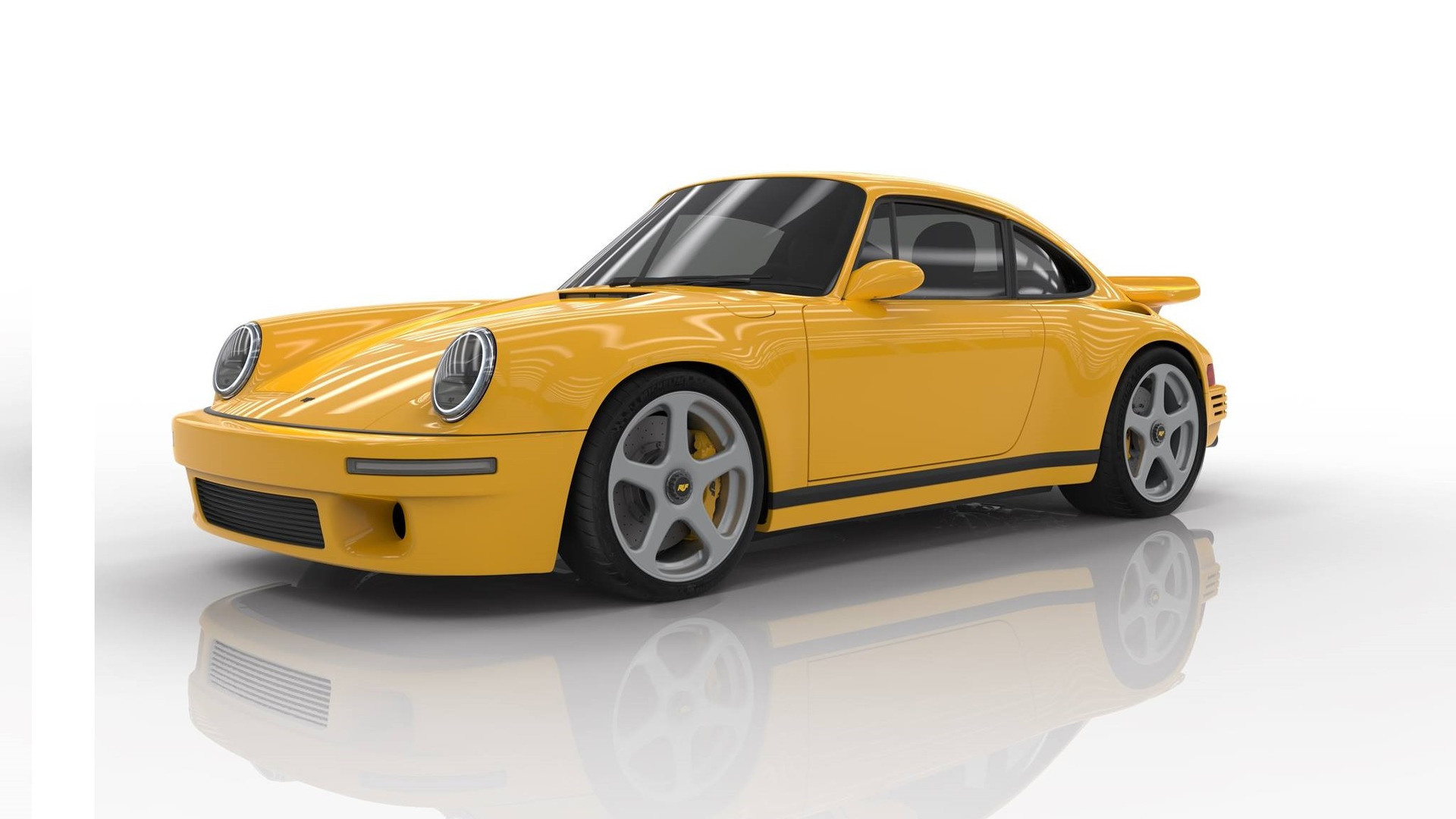
Geneva, Switzerland, March 7, 2017 – Revered sports car manufacturer RUF
Automobile GmbH unveiled the latest generation of its famed CTR halo car today during
the 87th Geneva Motor Show. This is the first RUF sports car to be based on a chassis
completely of the firm’s own design with a body that pays tribute to the 1987 CTR
“Yellow Bird.”
“The concept for the 2017 CTR is one that I have had in my head for a very long time,”
said Alois Ruf, President and owner of RUF Automobile GmbH. “We have been waiting
for the right point in our history to build our own car and the 30th anniversary of the CTR
‘Yellow Bird’ is that moment.”

New Chapter in a David and Goliath Story
Entering its fourth generation, the latest high-performance RUF supercar pays homage
to the 1987 CTR Yellow Bird in both form and function. A weight-to-power ratio of only
3.5 lbs per horsepower, a first-ever rear-wheel drive bespoke carbon fiber monocoque
chassis and an incredibly powerful engine are only some of the ingredients that make
the latest CTR such a compelling work of automotive art.
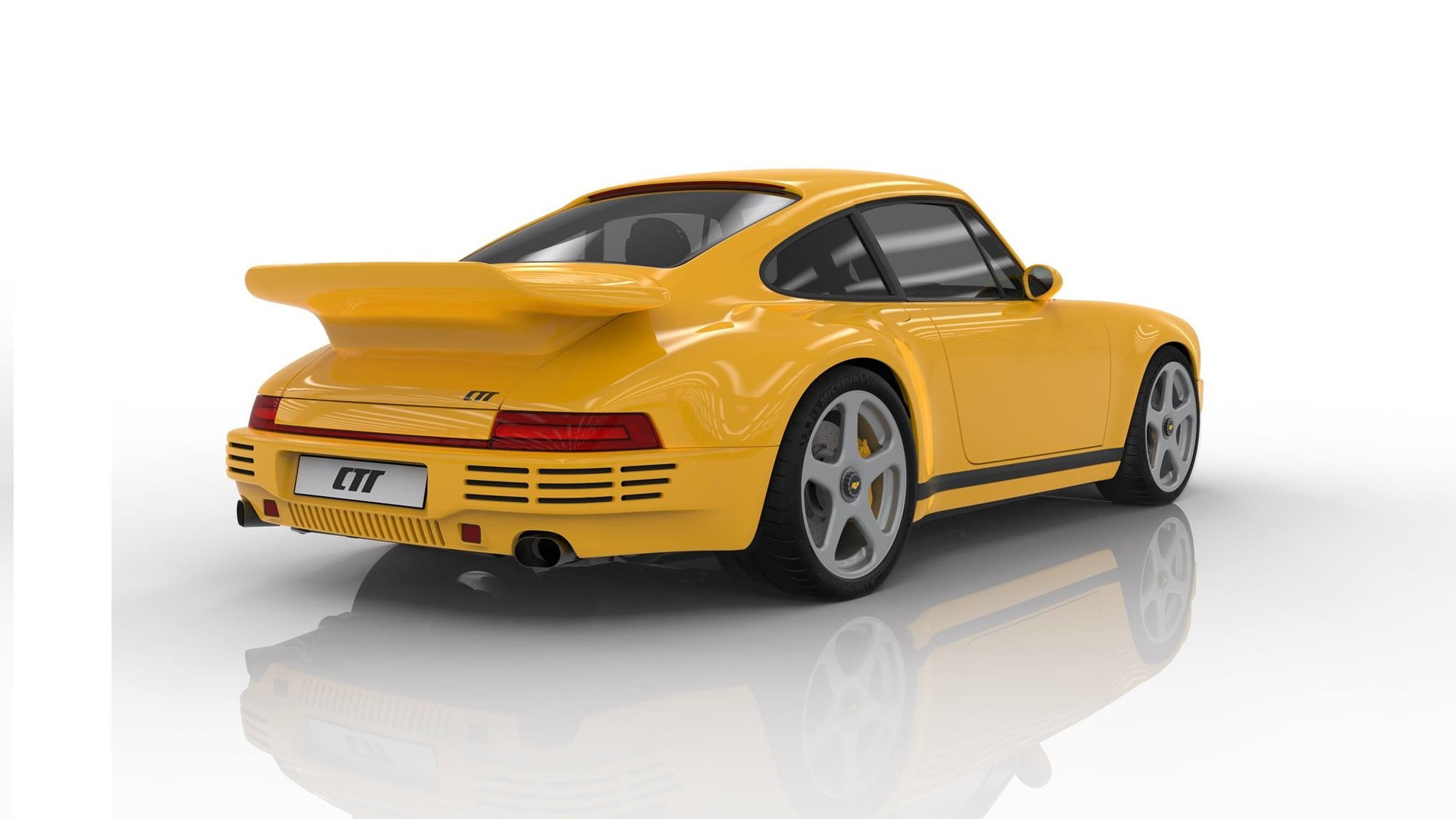
Design inspiration comes directly from the 1987 Yellow Bird’s focus on aerodynamic
efficiency. The silhouette, narrow body, rear air inlets and fascias are all direct nods to
the company heritage. The body, now formed in carbon, calls back to the original car’s
flushed look.
Center-locking 19-inch forged alloy wheels complete the design wrapped in tires
measuring 245/35ZR19 in the front and 305/30ZR19 in the rear.
Powerful, Traditional and Thoroughly Modern
Technological sophistication starts with the skin, which is made completely of carbon
fiber. For the first time, the chassis beneath that surface – also made of carbon fiber - is
a bespoke monocoque, a proprietary RUF design. The front and rear crash structures
are built with lightweight, steel as is the integrated roll cage that are both designed to
maximize occupant safety. In total, the extensive use of modern materials allows for an
extremely light dry weight of 1,200 kg (2,640 lbs).
Like most RUF works, the 2017 CTR uses a rear-engine powertrain layout. The 3.6-liter
twin-turbo flat-six is built by RUF and inspired by the design of the engine in the original
Yellow Bird. To that end, it uses a dry-sump lubrication system to provide constant oil
supply and pressure during extreme cornering. Total output is 522 kw (710 PS) at 6,750
RPM and 880 Nm (649 lb-ft) at 2,750 RPM, allowing acceleration from 0-100 km/h (62
mph) under 3.5 seconds and 0-200 km/h (125 mph) under nine seconds. Top speed is
360 km/h (225 mph).
In order to truly pay tribute to the Yellow Bird, the latest CTR will be available exclusively
with a newly-developed six-speed manual transmission that sends power to the rear
wheels through a limited-slip differential.
“We began development on the new CTR five years ago with the goal of creating a
thrilling, analog driving experience that combines an amazing power-to-weight ratio,
manual transmission and modern racing technology,” said Estonia Ruf.
Ensuring excellent handling characteristics, the 2017 CTR uses double-wishbone
suspension arms in a pushrod configuration for both the front and rear axles. Internally
vented and perforated carbon ceramic brake discs (380 mm front, 250 mm rear)
clamped by six-piston fixed calipers (front) and four-piston calipers (rear) offer maximum
stopping power and enduring fade resistance.
Minimalist Interior as a Mark of Analog Design
A minimalist two-seat interior designed with lightweight materials is a further
acknowledgement of the 2017 CTR’s analog philosophy.
Alcantara is the upholstery of choice both for its aesthetics and weight saving properties
that, in combination with leather and carbon fiber, give the cockpit a balance between
modern and retro design. The seats are made of carbon fiber, and the pedals from
aluminum. A three-spoke steering wheel is a further nod to the car’s racing pedigree, as
are the analog dial-type gauges in a green typeface.
Series production is scheduled to begin by 2018 at RUF’s Pfaffenhausen, Germany,
facility. The limited run will include 30 units not including the prototype unveiled during
the 2017 Geneva Motor Show. Pricing to be announced.
A Nickname Turned Legend
The RUF CTR debuted in 1987. Capable of incredible speed, the 469-bhp twin-turbo
CTR reached 342 km/h (213 mph) during testing on the Nardo Ring, a shocking speed
for its time that is still impressive to this day. It was in the same year that RUF gained
approval from the U.S. National Highway Transportation Safety Administration and
Environmental Protection Agency to sell its cars in America. Shortly thereafter, Alois Ruf
brought the car to Road & Track’s “World’s Fastest Car” competition at Volkswagen’s
Ehra-Lessien test track in Germany.
The CTR was one of nine cars in attendance including a Ferrari Testarossa, a
Lamborghini Countach 5000S and a Porsche 959.
The photographers from Road & Track noticed how the CTR’s bright paintwork stood out
against the coincidentally dull weather and gave it the nickname “Yellow Bird.” What
happened next would contribute to making that name stick forever.

About RUF Automobile Gmbh: In 1939, Alois Ruf Sr. first formed his company, AUTO
RUF, as a general service garage. Despite a challenging economy, the company grew
and in 1949 he added a gas station to the company complex. By 1955, Ruf Sr. recognized
a need in Germany for a full-size tourist bus and challenged himself to build his own tour
bus to run this as a separate business. In 1963, the company began specializing in
Porsche vehicles, a direction that Alois Ruf Jr. vowed to continue when he assumed
directorship of the company in 1974. In the following year, the first RUF-enhanced
Porsche model made its debut. Now it is still family run by Alois and Estonia Ruf.
Comments
Post a Comment