
1967
The Camaro was officially announced on June 28, 1966 by Chevrolet Division's General Manager Pete Estes. He had called in magazine and newspapers writers from 14 different markets onto one massive conference phone call, the first time this had ever been done. Estes brought the people on for the first and last meeting of the Society for the Elimination of Panthers from the Automotive World (SEPAW). Panther was the nickname that had been given to the car during its testing period, while GM marketers found the name Camaro in the 1935 edition of Heath's French to English Dictionary, translating to "friend, pal, or comrade." It was also joked that a Camaro was "a small, vicious animal that eats Mustangs."

The Camaro was undoubtedly a direct response to the success of Ford's pony car, and its design reflected that. The car had a long hood, a short rear deck, two-door configuration and a 2+2 set up. The car was originally launched with Sport Coupe (which had a lower price point than the Mustang at $2,466), Rally Sport and Super Sport trims. The base engine was a 140hp inline-six, while 5.7L and 6.2L V8s were available in the SS and the later-debuting race-ready Z/28 trim had a 4.9L small-block V8. There were a plethora of options for transmissions, including a three- and four-speed manuals and a two-speed automatic. In its first year of existence, the Camaro had the honor of pacing the Indianapolis 500.
1968
In its sophomore year, the Camaro saw a few minor aesthetic changes. Per government regulations, side marker lights were placed on the front and rear fenders. Chevy also got rid of the side vent windows, put a little bit of separation between the lamps in the taillight units, and pointed the grille a bit more. This car saw success in sales and on the track, as well, winning the Trans-Am championship that year. The car's 396-cu-in big-block V8 was available in 325-, 350, and 375-horsepower levels. You knew an SS was coming at you by its signature bumblebee stripe on the front.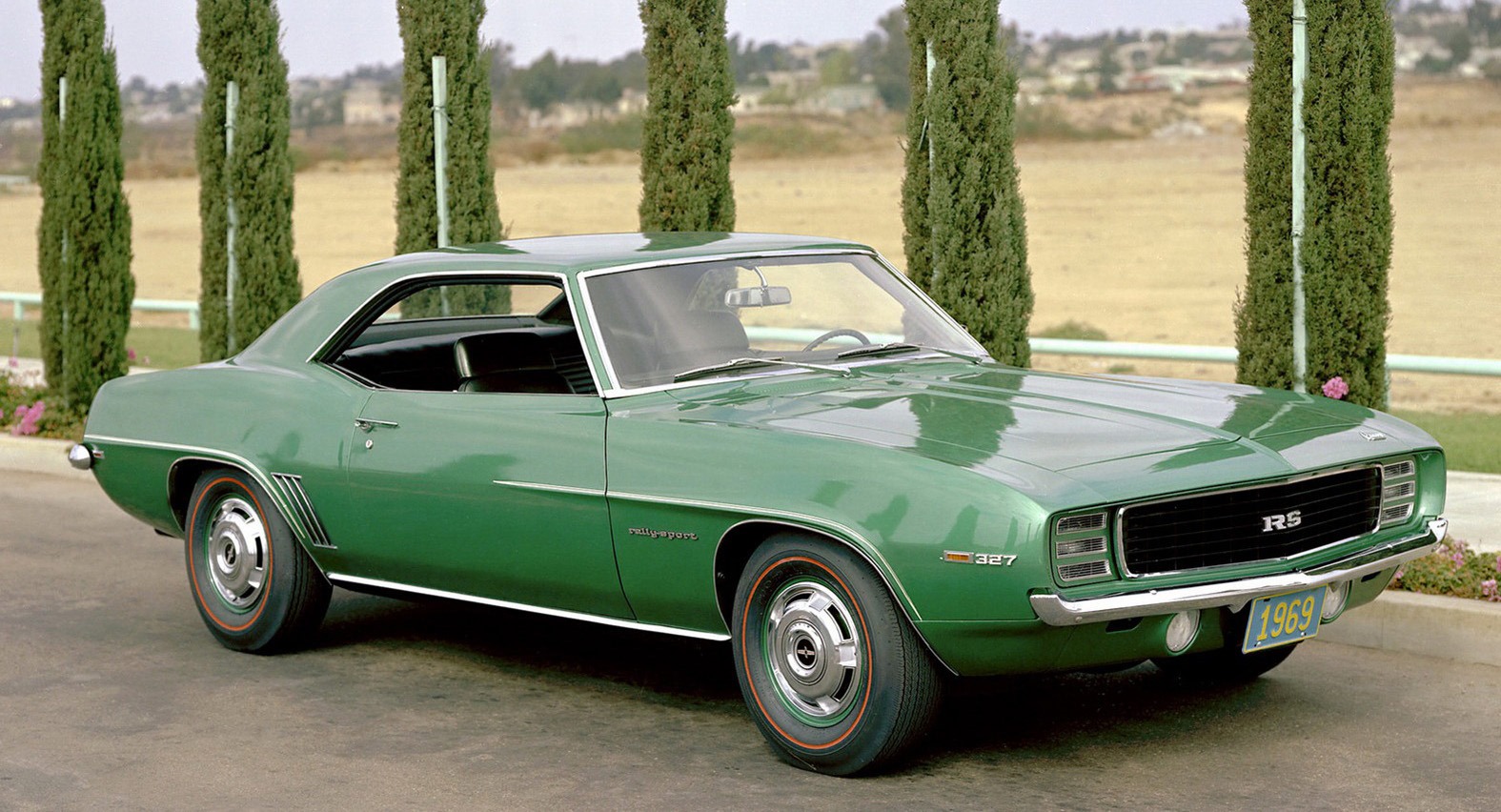
1969
1971
1972


The Camaro was undoubtedly a direct response to the success of Ford's pony car, and its design reflected that. The car had a long hood, a short rear deck, two-door configuration and a 2+2 set up. The car was originally launched with Sport Coupe (which had a lower price point than the Mustang at $2,466), Rally Sport and Super Sport trims. The base engine was a 140hp inline-six, while 5.7L and 6.2L V8s were available in the SS and the later-debuting race-ready Z/28 trim had a 4.9L small-block V8. There were a plethora of options for transmissions, including a three- and four-speed manuals and a two-speed automatic. In its first year of existence, the Camaro had the honor of pacing the Indianapolis 500.
1968
In its sophomore year, the Camaro saw a few minor aesthetic changes. Per government regulations, side marker lights were placed on the front and rear fenders. Chevy also got rid of the side vent windows, put a little bit of separation between the lamps in the taillight units, and pointed the grille a bit more. This car saw success in sales and on the track, as well, winning the Trans-Am championship that year. The car's 396-cu-in big-block V8 was available in 325-, 350, and 375-horsepower levels. You knew an SS was coming at you by its signature bumblebee stripe on the front.
1969
Sales numbers really jumped up in '69, with the Camaro pushing 243,085 units off the lots. Part of the success was due to the refreshed styling, which saw skinnier three-block taillights, two large round headlights pushed all the way to the sides of the grille, a pointier front fascia, and slightly reworked body panels. If the buyer chose the RS trim, the headlights were made flush with the grille, and three stacked slits covered the lights. This was also the first year that variable-ratio power steering became an option. SS trims offered a 300hp 350 V8 or a 375hp 396. Largely considered one of the most beautiful cars of all time, the '69 would later provide direct inspiration for the fifth-gen Camaros.
1970
It only took three years before Chevrolet decided it needed to completely redesign its pony car. The redesigned '70, the first of the second generation had a much more European feel, drawing some comparisons to cars like the Ferrari 250GT Berlinetta Lusso. Although the hood remained extremely long, it was no longer flat. The headlights were worked into the front body panels with large individual bulges, and the grille was much smaller in width, sculpting its way into the hood for a bit of a scoop look. The car also had a "chin" beneath the front end of the car and an integrated rear spoiler, both of which created downforce. The convertible model was cut out from the lineup, and the Z28 no longer had the slash in its name. Designers caught a lot of flack for the car's vulnerable front end, but there was no question this was one of the most gorgeous cars in the world, at the time.

1971
Although the '71 model year now had standard features like the power front disc brakes and defroster and the option of a vinyl top, performance numbers took a bit of a hit. The six-cylinder went down 10 horses, the Z28 350 V8 dropped 30, and the hefty 396 lost a whopping 50 horses. This was due to lowered compression ratios. Chevy sales also took hits from a two-month corporate strike and hesitation to buy pony cars due to high insurance rates.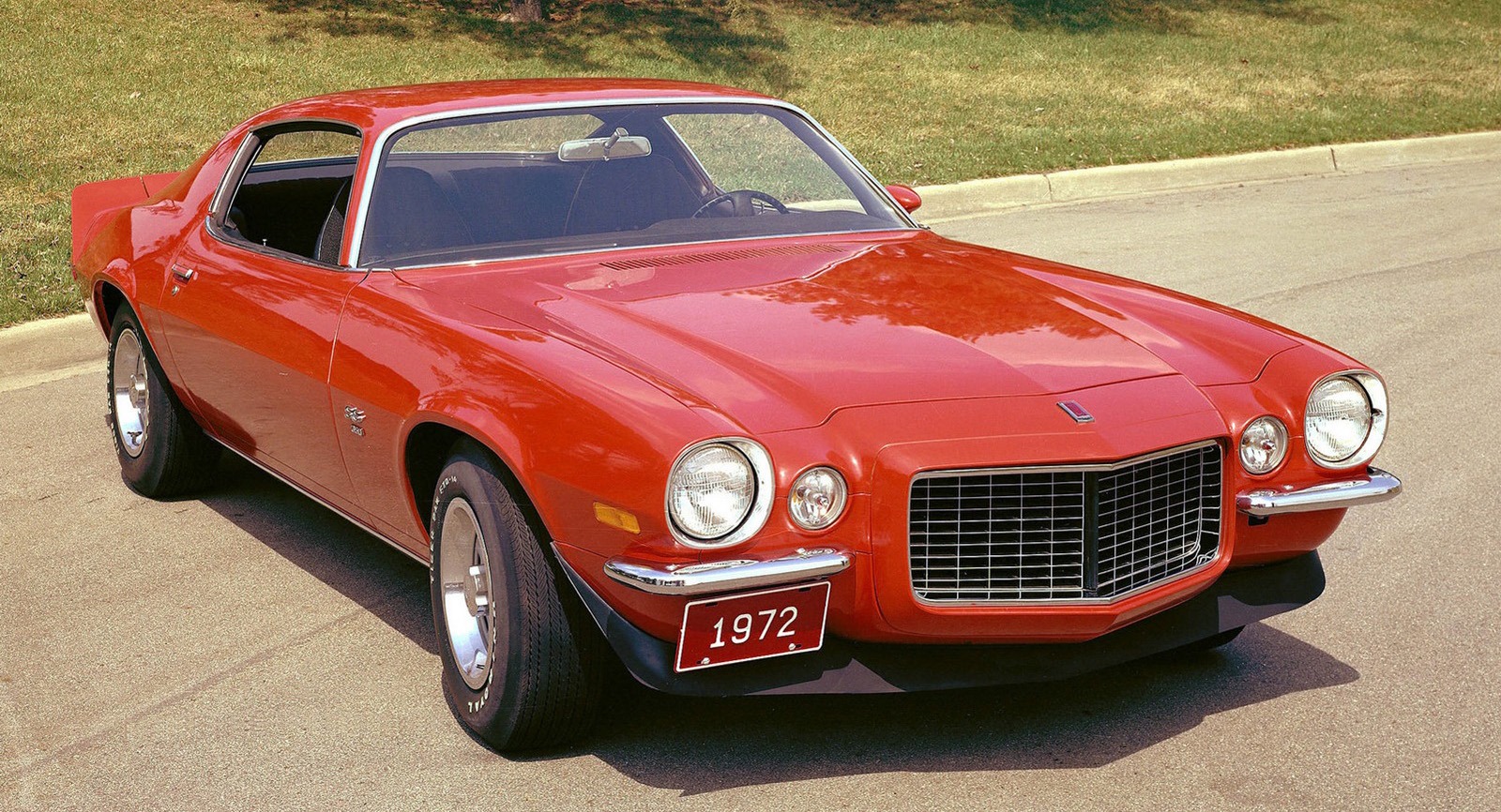
1972
The Camaro took another hit in '72, when a workers at the Norwood, OH plant were on strike for six months, halting production and causing Chevrolet to scrap thousands of partially built cars due to the fact that the builds wouldn't meet government regulations for '73. The tough times put Chevy in a hard situation, and a few considered ending the run of the pony car. Lucky for everybody, they were convinced otherwise behind the idea of how strong the car's following was. This was the final year of the SS 396 and 350 models, and power ratings dropped immensly once the governmen switched from gross to net ratings. This meant the power numbers were based on an engine in a real functioning vehicle. That put the 396/402 at 240 net horsepower compared to 300 the year before.

1974

1975
Aside from Chevy dropping the Z28 trim, the biggest change in the Camaro this year was the new wrap-around rear window. No longer was there an awkward and chunky pillar. The new look created a much more fluent and smoother appeal. A catalytic converter was also added to the '75 model. After Ford had downsized the Mustang and Chrysler got rid of the Barracuda and Challenger, the Camaro and the Firebird were the only traditional pony cars left on the market.
Enter the full-length bumper. The redesigned Camaro no longer had the dramatic nose that made it so strikingly European before. Instead, it had a strip of aluminum across the entire front end, a feature required to meet goverment safety standards. This was met by a ramped grille that sloped up toward the hood. The tail saw a new look, as well, saying good bye to the round separated lamps and hello to blocks that wrapped around the rear body panel. The LT (Luxury Touring) trim was introduced this year, as consumers looked for more luxury in the cars they were purchasing.
1975
Aside from Chevy dropping the Z28 trim, the biggest change in the Camaro this year was the new wrap-around rear window. No longer was there an awkward and chunky pillar. The new look created a much more fluent and smoother appeal. A catalytic converter was also added to the '75 model. After Ford had downsized the Mustang and Chrysler got rid of the Barracuda and Challenger, the Camaro and the Firebird were the only traditional pony cars left on the market.
1977
After a two year absence, Chevy decided to bring back the Z28 trim. The revived model had a stiffer suspension, painted rally wheels, bigger tires, more reactive steering, a large spoiler, graphics, and a dual-resonator exhaust system. Under the hood was a 350 V8 that produced 185 horsepower. At this point, most cars were being sold with air conditioning and automatic transmissions, but there was still the option for a Borg-Warner Super T-10 4-speed manual transmission.
After a two year absence, Chevy decided to bring back the Z28 trim. The revived model had a stiffer suspension, painted rally wheels, bigger tires, more reactive steering, a large spoiler, graphics, and a dual-resonator exhaust system. Under the hood was a 350 V8 that produced 185 horsepower. At this point, most cars were being sold with air conditioning and automatic transmissions, but there was still the option for a Borg-Warner Super T-10 4-speed manual transmission.
1981
Sales took a fall in the '80 and '81 model years, as Chevy was already looking ahead to the next generation of Camaros. By '81, the car was only available in standard, Berlinetta and Z28 trims. The Z28, however, was not the most powerful machine, as horsepower from its 350 V8 dropped from 190 to 165.
Sales took a fall in the '80 and '81 model years, as Chevy was already looking ahead to the next generation of Camaros. By '81, the car was only available in standard, Berlinetta and Z28 trims. The Z28, however, was not the most powerful machine, as horsepower from its 350 V8 dropped from 190 to 165.
End of part one
Text and images by www.complex.com
Text and images by www.complex.com
Comments
Post a Comment