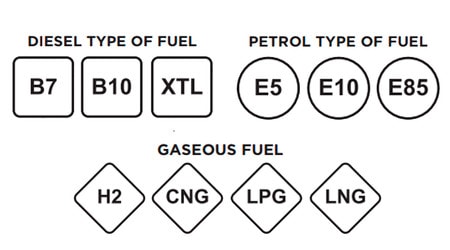
Today, a new harmonised set of fuel labels will appear across Europe. They will give drivers better information on the suitability of fuels for their vehicles wherever they travel in the EU, helping them avoid misfuelling and informing on the environmental impact of their choice.
Alternative fuels can help reduce Europe's air quality problems, much of which are caused by transport emissions. However, the growing diversity of fuels available on the European market means that drivers, businesses and fuel station operators need clearer information on fuels sold at filling stations From now on, when customers arrive at a public filling station of any Member State, they will notice new EU-wide harmonized fuel symbols on fuel dispensers and fuel nozzles. The same harmonised, easy-to-read, clear and simple labels will also be compulsory for newly produced vehicles and will be shown on the fuel-filler caps. These new labels do not replace existing names and brands of fuels, nor quality, safety, and performance recommendations. The labels are based on industry standards and have been developed by European standardisation bodies with the participation of industry, consumer and civic society representatives.
This initiative is taken on the basis of Article 7 of the Alternative fuels infrastructure Directive of October 2014 and is in line with the Commission's Action Plan on Alternative Fuels Infrastructure, adopted in November 2017, which sets out a number of support actions to accelerate the roll out of infrastructure, increase investments and improve consumer acceptance. It also complements the Juncker Commission's proposals "Europe on the Move" for a clean, safe and connected mobility.
The new labels are divided in to three groups:
Gasoline-type fuels: marked by an “E” inside a circle: E5, E10, etc (“E” stands for specific bio-components (ethanol) present in petrol);
gasoline type fuels
Diesel-type fuels: marked by a “B” inside a square: B7, B10, XTL, etc (“B” stands for specific biodiesel components present in diesel, the XTL stands for synthetic diesel and indicates that it is not derived from crude oil);
diesel type fuels
Gaseous-type fuels, mentioning their specific subtype within a rhombus/diamond: e.g. CNG, LNG, LPG and H2 (hydrogen);
gaseous type fuels
In the case of newer vehicles, the labels will also be visible in the owner's manual and they may also appear in the electronic handbook available via a vehicle's infotainment center. Besides being visible in all public refueling stations, they should also be visible at vehicle dealerships. The new labels will be deployed in all 28 European Union member states, EEA countries (Iceland, Lichtenstein and Norway), and also Macedonia, Serbia, Switzerland and Turkey.
Background
Today, transport still relies on oil for a large part of its energy needs. Energy efficiency in transport and effective transport management can substantially contribute to reduce emissions and oil consumption. One way of doing so is investing in alternative fuel solutions, which can help decarbonise transport by gradually substituting the fossil energy sources which are responsible for the CO2 emissions from transport. Research and technological development have led to successful demonstrations of alternative fuel solutions for all transport modes. Market take-up, however, requires additional policy action. To solve this issue, in 2014, as part of the Clean Power for Transport strategy, Directive 2014/94/EU on the deployment of alternative fuels infrastructure was adopted, aiming to facilitate the development of a single market for alternative fuels for transport in Europe.
The Directive also called for a way for setting up appropriate consumer information on fuels, including a clear and sound indication of the compatibility between different fuels and cars. The call for better consumer information arose from the multiplicity of fuel choices becoming available on the market, in particular with the roll-out of new alternative fuels.
In view of this increasing choice of fuels facing consumers, the Directive mandated the European Committee for Standardization (CEN) to come up with industry-wide standards that would improve existing information. CEN adopted on 12 October 2016 standard EN 16942, "Fuels-Identification of vehicle compatibility-Graphical expression for consumer information", which enters into force 2 years later, on 12 October 2018. A new standard “EN 17186:2019” laying down harmonized identifiers for power supply for electric road vehicles is expected to be adopted early 2019.
In May 2018, the Commission also adopted an Implementing Regulation on Fuel Price Comparison which establishes a common methodology to facilitate the comparison of prices of the different fuels in a common unit (euro/ national currency) taking into account the energy content of the fuel and the energy efficiency of the vehicle.
Comments
Post a Comment