

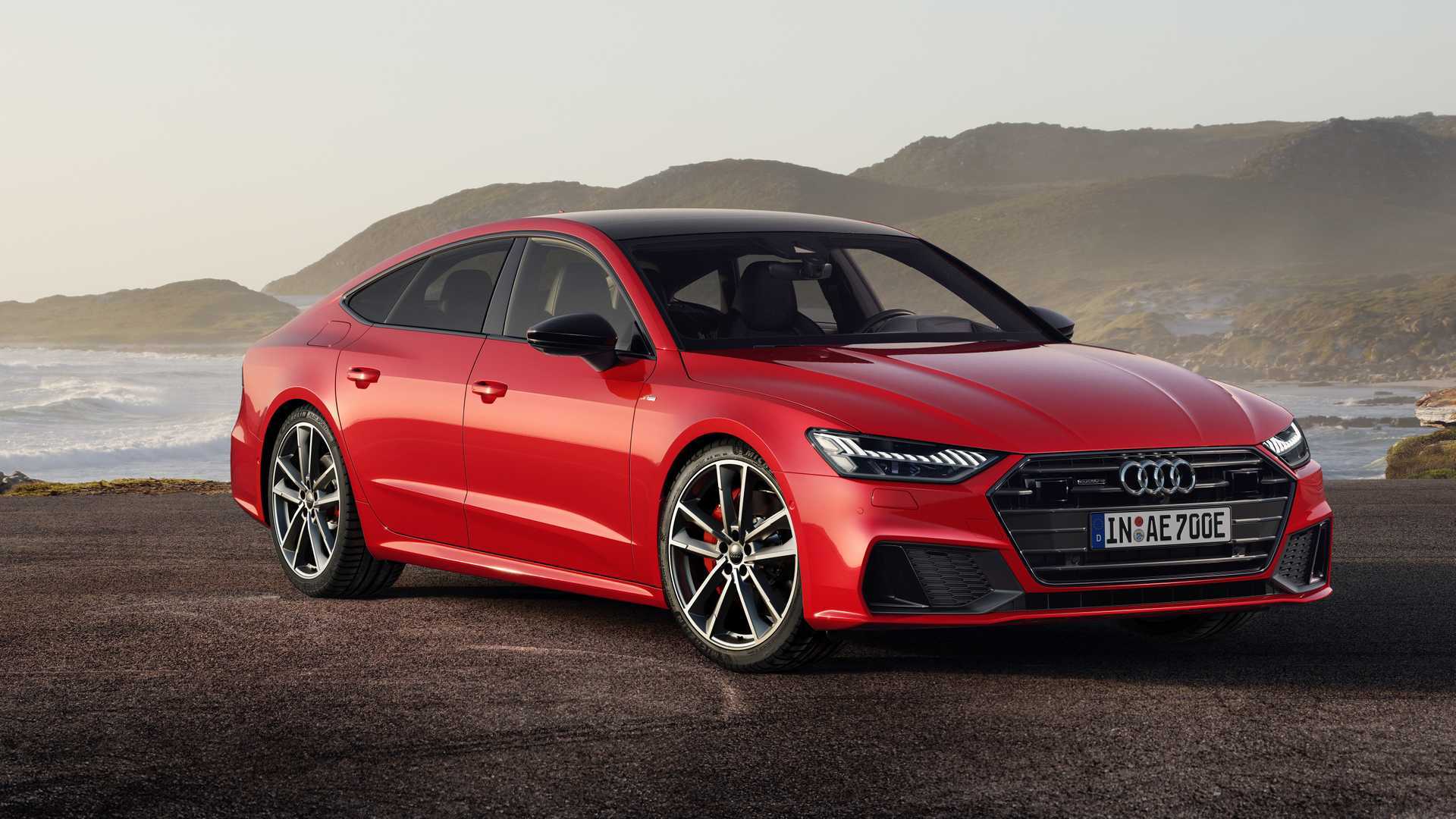
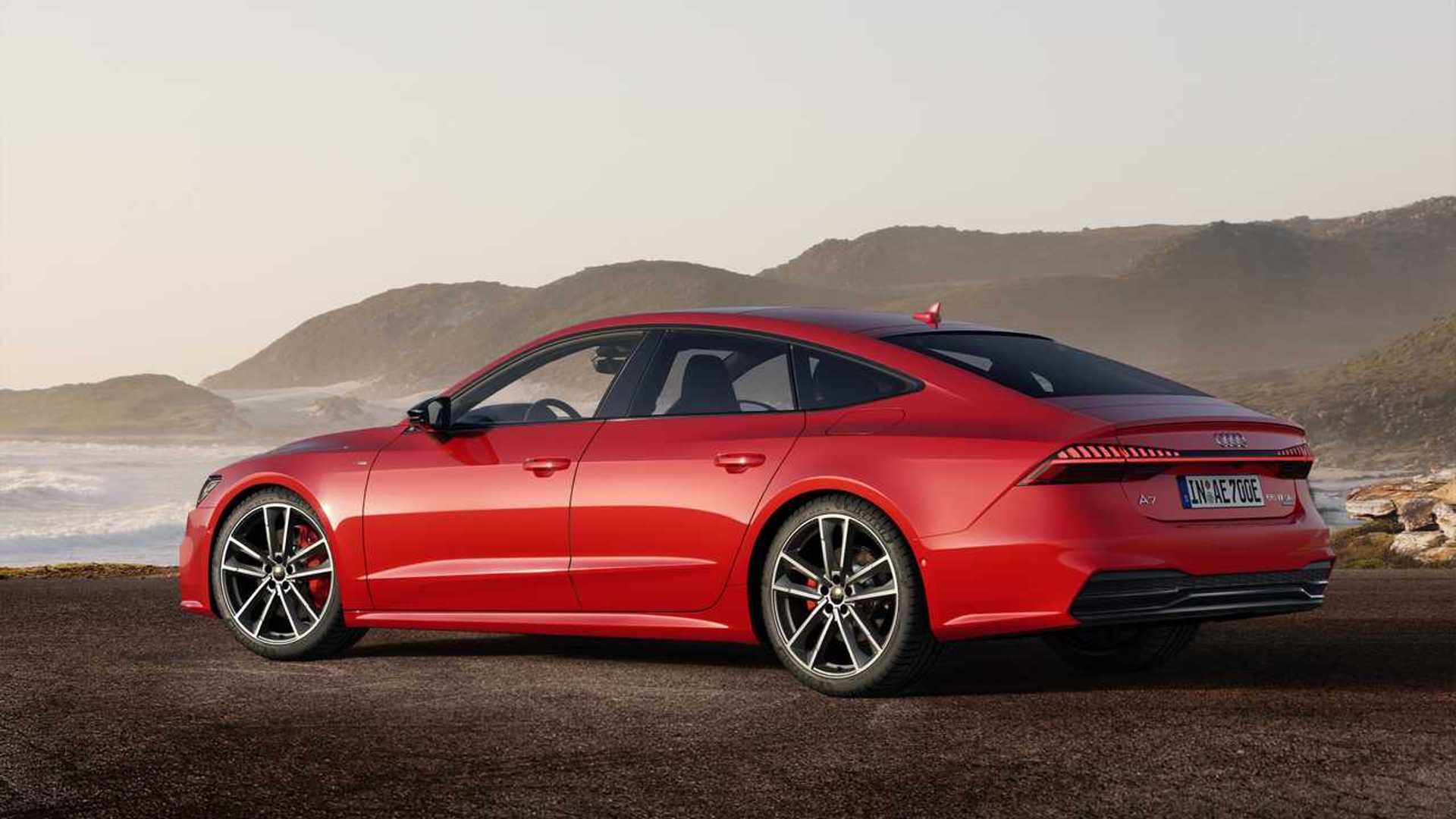


 Audi is systematically pursuing its electrification strategy and is now offering its large four-door coupe as a powerful and efficient PHEV. Intelligent drive management with a predictive operating strategy enables high electric range, low fuel consumption and dynamic performance. The new Audi A7 Sportback 55 TFSI e quattro combines all of that with a system output of 270 kW (367 PS) (combined fuel consumption in l/100 km*: 2.1 – 1.9 (112.0 – 123.8 US mpg); combined electrical consumption in kWh/100 km*: 18.1 – 17.5; combined CO2 emissions in g/km*: 48 – 44 (77.2 – 70.8 g/mi)). A comprehensive list of standard equipment with S line exterior package and sport suspension round out the sporty look.
* Angaben zu den Kraftstoff-/Stromverbräuchen und CO2-Emissionen bei Spannbreiten in Abhängigkeit vom verwendeten Reifen-/Rädersatz sowie von der gewählten Ausstattung.
The drivetrain of the new plug-in hybrid Audi A7 Sportback 55 TFSI e quattro comprises a turbocharged 2-liter, four-cylinder gasoline engine with an output of 185 kW (252 PS) and 370 Nm (272.9 lb-ft) of torque and an electric motor (combined fuel consumption in l/100 km*: 2.1 – 1.9 (112.0 – 123.8 US mpg); combined electrical consumption in kWh/100 km*: 18.1 – 17.5; combined CO2 emissions in g/km*: 48 – 44 (77.2 – 70.8 g/mi)). The permanently excited synchronous motor (PSM) has a peak output of 105 kW and peak torque of 350 Nm (258.1 lb-ft). Together with the separating clutch, it is integrated into the seven-speed S tronic, which uses ultra technology to transfer the drive torque to a quattro ultra drivetrain. Total system output is 270 kW (367 PS); the maximum torque of 500 Nm (368.8 lb-ft) is already available at just 1,250 rpm. The A7 PHEV accelerates from 0 to 100 km/h (62.1 mph) in 5.7 seconds and reaches a top speed of 250 km/h (155.3 mph). As a company car, the plug-in hybrid model is subject to a lower tax rate in Germany because its electric range in the WLTP cycle is more than 40 kilometers (24.9 mi). The A7 Sportback can drive at up to 135 km/h (83.9 mph) in electric-only mode, making emissions-free highway driving easy.
Comprising 104 pouch cells, the lithium-ion battery stores 14.1 kWh of energy at a rated voltage of 381 volts beneath the luggage compartment floor. For optimal temperature control, its cooling loop is connected to both the coolant loop for the climate control system and the low-temperature cooling loop into which the electric motor and power electronics are also integrated.
The lithium-ion battery is integrated into the rear of the vehicle below the luggage compartment floor in such as way that there is no step in the luggage compartment. Maximum usable stowage capacity with the rear seat folded down is thus 1,235 liters (43.6 cu ft).
quattro all-wheel drive in a plug-in hybrid
Typically Audi, the A7 Sportback 55 TFSI e** is also equipped with quattro all-wheel drive with ultra technology. The rear axle is activated lightning fast and predictively as needed. Recuperation of electrical energy is always via the front axle. The quattro all-wheel drive concept and the overall concept of the A7 PHEV thus stand equally for performance and efficiency. With the four-door Gran Turismo, Audi is the only premium manufacturer in the direct competitive environment to offer a plug-in hybrid with all-wheel drive.
Easy operation with three driving modes
The drive concept of the A7 Sportback 55 TFSI e quattro is designed so that customers can do the most of their daily driving electrically. Whether with zero local emissions in the city or with high range on long trips. The combination of electric motor and internal combustion engine provides for a sportily dynamic driving experience. With its three different driving modes, the plug-in hybrid is easy to operate in everyday use.
The A7 PHEV starts by default in EV mode. This means the car is driven exclusively electrically as long as the driver does not depress the accelerator past a variable, perceptible pressure point. EV mode is the base setting each time the vehicle is started. In the second driving mode, Battery Hold mode, the drive management system holds battery capacity at the current level so that a defined distance can later be covered fully electrically, for instance.
The Hybrid mode is activated either automatically together with route guidance in the navigation system or by the driver using the operating mode button. In this mode, the A7 PHEV uses the interplay between the electric motor and the internal combustion engine to complete as many driving segments as possible electrically so that overall fuel consumption at the end of the trip is as low as possible. For instance, stop-and-go traffic in cities can be driven electrically for the most part. Depending on the situation, the system chooses between freewheeling with the engine switched off and coasting recuperation. Up to 35 kW of power can be recovered with the latter. The electric motor is responsible for all light braking up to 0.1 g, i.e. the majority of braking in everyday driving. A maximum of 80 kW of electrical energy are generated via braking recuperation at a deceleration of up to 0.2 g.
Predictive operating strategy and predictive efficiency assist
For maximum efficiency the A7 uses predictive drive management – the predictive operating strategy. It uses information from the predictive efficiency assist also found in other Audi mid- and full-size class models to control the electric motor, lithium-ion battery and the internal combustion engine.
If route guidance is active in the MMI navigation system, the predictive operating strategy controls the drivetrain so that the last urban section of the route can be driven exclusively electrically and the Audi A7 PHEV arrives at the destination with the drive battery nearly empty. If the A7 Sportback TFSI e approaches a town, the drive management charges the battery so that the last urban section can be driven electrically. The driver can thus use all of the electric energy to drive with zero local emissions upon entering a town.
Drive management is controlled on the basis of a large amount of data. The predictive operating strategy uses two types of data, near field and route information, for rough and precision planning of the route. The rough planning is based on online traffic information, distance to the destination, the route profile of the chosen route, precise information about immediate surroundings from the navigation data, such as speed limits, types of roads,
uphill and downhill slopes and the latest data from the onboard sensors. The drive controller’s rough planning is therefore based primarily on route information along the driven route, such as traffic flow, topography and road type. Precision planning, with which the A7 manages the drive controller in the current driving situation, is performed by the predictive efficiency assistant (PEA) found in other Audi mid- and large-size class models.
The predictive efficiency assistant adjusts coasting recuperation behavior to the driving situation at hand. It uses the predictable route data from the navigation database and monitors the distance to the vehicle ahead using signals from the camera and radar. Depending on the situation, the system chooses predictively between freewheeling with the engine switched off and coasting recuperation, i.e. the recovery of kinetic energy and its conversion into electrical energy. When the adaptive cruise control (ACC) is active, the PEA supports the driver by automatically braking and accelerating with the aim of enhancing efficiency and comfort.
A haptic pulse from the active accelerator pedal and an optical signal in the driver information system display as well as the optional head-up display provide additional support for the greatest possible efficiency. The active accelerator pedal has both a haptic pressure point that signals the end of electric-only driving and haptic feedback that signals the driver to take their foot off of the accelerator.
Convenient: fast charging in a short time
The charging system compact comes standard with the Audi A7 Sportback 55 TFSI e quattro**. A Mode 3 cable with Type 2 plug for use at public charging terminals is available as an option. The charging system compact comprises cables for household and industrial outlets plus a control unit. The system features an LED status display and safety functions such as temperature and residual current monitoring. Audi offers the clip wall mount, a lockable holder for the charging system, as an option.
A full charge at a three-phase CEE industrial outlet with 400 volts and 16 amperes per phase takes just approximately 2.5 hours. The vehicle charges with a maximum of 7.4 kW. Even a 230 volt household outlet can recharge an empty battery fully and conveniently overnight in approximately seven hours. Convenient recharging is also possible on the road. The proprietary Audi e-tron Charging Service provides access to more than 100,000 charging points in Europe. A single card is sufficient to start charging, regardless of the provider.
A constant eye on the state of charge: the myAudi app
The myAudi app allows customers to use the services from the Audi connect portfolio on their smartphones, which is particularly practical with electrified models. The app can be used to check the battery and range status, start the charging process, program the charge timer and view the charge and consumption statistics. Furthermore, the route planners in both the app and the MMI navigation in the car show charging stations.
Another function of the myAudi app is pre-entry climate control before setting off. The air conditioning compressor and the auxiliary heater in the car are electrically powered. The customer can determine exactly how the interior should be heated or cooled while the battery is being charged. Depending on the optional equipment chosen, the same applies to the seat and steering wheel heating, heating of the windshield, rear window and mirrors, and the seat cooling.
Clever thermal management
The air conditioning works together with a highly efficient heat pump, enabling the car to make good use of the waste heat from the electric drive train. This is particularly economical and not only enables the interior to be heated or cooled quickly, but also a high electric range even at particularly high or low outdoor temperatures.
Sporty appearance and comprehensively equipped
The Audi A7 Sportback 55 TFSI e** not only scores points against its direct competitors with sporty performance, but also with a correspondingly dynamic appearance package and comprehensive list of standard equipment. The standard S line exterior package combined with the black styling package and the privacy glazing underscore the sporty overall impression of the four-door Gran Turismo even when standing still.
HD Matrix LED headlights, sport seats, four-zone automatic air conditioning, convenience key, Audi virtual cockpit, PHEV-specific displays, 19-inch, multi-spoke wheels and red brake calipers front and rear are standard.
Orders are now being accepted for the Audi A7 Sportback 55 TFSI e quattro** at a base price in Germany of 77.850 euros. Market introduction begins in the third quarter of 2019.
Fuel consumption of the models named above:
Audi A7 Sportback 55 TFSI e quattro: Combined fuel consumption in l/100 km*: 2.1 – 1.9 (112.0 – 123.8 US mpg); Combined electrical consumption in kWh/100 km*: 18.1 – 17.5; Combined CO2 emissions in g/km*: 48 – 44 (77.2 – 70.8 g/mi).
Comments
Post a Comment