
First Up-Close Look at the GR GT

Alfa Romeo Navajo

The final 33 Stradale-based dream car was Bertone’s Navajo that debuted in March 1976 at the Geneva Salon.


The Navajo symbolised the new accord between the Turin bodywork designer and Alfa Romeo, a partnership which over the years had turned out many world famous cars. Names like the Giulietta SprintCanguro, Giulia GT, Carabo and Montreal evoke fundamental steps in the evolution of the sports car.

Despite its intentional design excesses, the Navajo represents a concrete idea for a sporty coupé based on the prestigious mechanics of the Alfa 33. The original tubular chassis was lengthened and adapted to create optimum room for two passengers. The bodywork, entirely in fibreglass, together with the chassis, gives an excellent result in terms of weight. Given the availability of generously powerful engines, the Bertone designers focussed their attention on the aerodynamic questions related to road holding, as well as thinking of pure speed. The Navajo benefits from this approach both in general design terms, and as far as accessories are concerned. The frontal view is extremely tapered, reducing air resistance to a minimum, and to this end, the car also features a brand new and very original front spoiler, which automatically regulates the angle with the ground according to the speed of the vehicle.
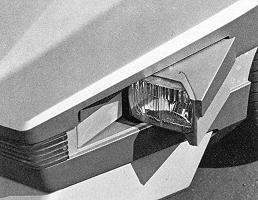
 
The rear wings, aside from providing an interesting aesthetic motif, represent a valid support for the generous rear spoiler, which is also adjustable. The disappearing headlamps open horizontally to the plane of the car.

Presented at the Geneva Motor Show in March 1976, the Navajo captured the attention of public and experts alike: the avant-garde solutions on show were yet another demonstration of the designer’s unique style, constantly experimenting and ahead of its time.

Source: carstyling.ru; www.qv500.com; www.bertone.it

Comments

Popular posts from this blog

Cute girl drifting in rally car unfastened

The 9th Dream Car from the Top 10: GM-X Stiletto

When we think of dream cars, our minds often race to sleek designs, innovative technology, and that unmistakable feeling of pure, unbridled passion. The GM-X Stiletto encapsulates all of these elements and more, making it a worthy contender in our top ten list. Ranked at number nine, this concept car from 1964 remains a beacon of automotive ingenuity and a symbol of a bygone era that continues to inspire. A Journey Back to the Jet Age To fully appreciate the GM-X Stiletto, we must travel back to the 1950s and '60s, a time when America was captivated by the future. The jet-age was in full swing, and cars were designed with a sense of bold optimism. Under the visionary leadership of Harley Earl and Bill Mitchell, General Motors created vehicles that mimicked the sleek lines and advanced technologies of jet aircraft. The GM-X Stiletto, born in 1964, was a product of this era's boundless imagination. The Visionary Design The GM-X Stiletto was first unveiled at the 1964-1965 World’s...

【中継】日産モータースポーツファンイベント

Bass And Boobs + Skirt Trick & Can Trick

10 Newest Cars and SUVs by South Korean Manufacturers (2025-2026 Lineup ...

Chevrolet Concept Cars: Ten Of Our Favorites

Most celebrations of Chevrolet's centennial surround the automaker's production vehicles. Why not? After all, this is the brand that birthed legends like the Bel Air, Corvette, and Camaro, among others. Those vehicles are certainly worth celebrating, but we can't help but wonder: what about the Chevrolet cars that never saw a production line? We've scoured through the history books (and our memory banks) to pick out ten of our all-time favorites.

Chevrolet Racing Claims 14 Championships in 2013

1985 Audi Sport Quattro: The Group B Homologation Special

In Austria in 1980, just a year after four-wheel drive cars became eligible to compete in the WRC, Audi debuted the first Quattro rally car and forever changed the sport. Over the next half of the decade (and onwards, if you count the Pikes Peak specials), these Audis would be subjected to a period of rapid iterative evolution that led to the short-wheelbase Sport Quattro models that helped define the infamously fast and dangerous era of Group B rallying. The relatively lax nature of the Group B regulations gave rise to a number of downright ferocious cars from Audi’s competitors (most notable being Lancia and Peugeot), and while it was not the most successful nor technologically advanced of these top tier cars by the end of the Group B era, the Sport Quattro is a worthy poster child for the lot of them—being first to the punch has its advantages. The advent of the Group B class provided manufacturers with practically every leeway imaginable given they adhered to a basic s...

Never Born:The Cadillac CTS Wagon

Cool Lamborghini Wallpaper - 350 GT

Labels

Show more