


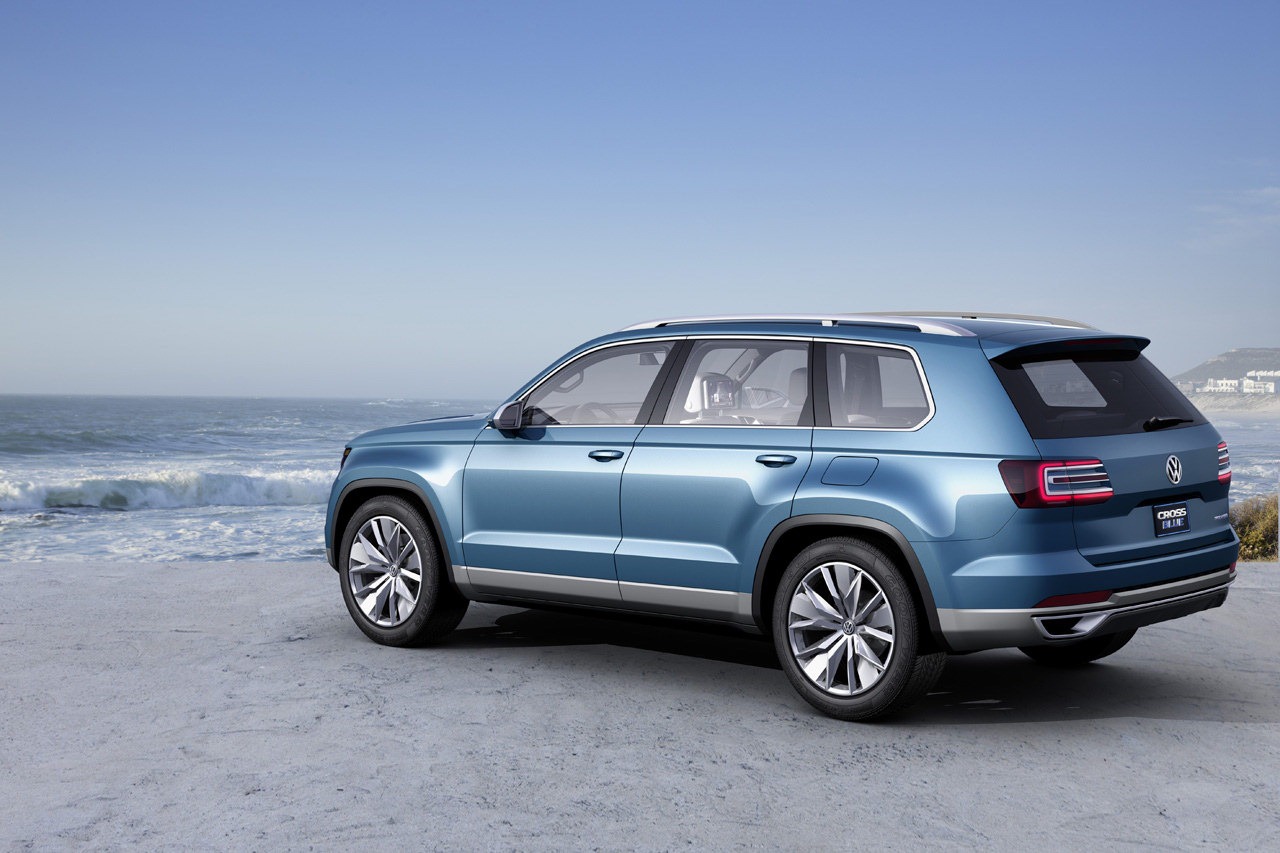
Wolfsburg/Detroit - The versatile CrossBlue SUV concept that is making its global debut at the North American International Auto Show was developed specifically for the U.S. and Canada. If it goes into production, the CrossBlue would flesh out the Volkswagen SUV lineup with a seven-seat midsize crossover that slots in above the Tiguan and below the premium Touareg.
The CrossBlue features a highly innovative plug-in hybrid powertrain that mates a TDI® Clean Diesel engine with two electric motors, a DSG® dual-clutch automatic transmission, and an electric all-wheel-drive system that is dubbed "propshaft by wire." Volkswagen's manufacturer estimated fuel economy rating is 89 mpge combined in electric mode and 35 mpg as a hybrid. As well as offering excellent economy for a mid-size crossover SUV, the CrossBlue has impressive performance from a powertrain that produces up to 305 horsepower and 516 pound-feet of torque: 0 to 60 mph is estimated to take just 7.2 seconds.
The CrossBlue runs in zero emissions mode either at the press of a button or automatically. With a fully charged 9.8kWh lithium-ion battery, the CrossBlue can travel a distance of 14 miles in all-electric mode; to achieve optimal driving range, the top speed is reduced from 127 mph to 75 mph. The overall driving range is 661 miles if the 18.5-gallon fuel tank is filled with ultra-low-sulfur diesel fuel.
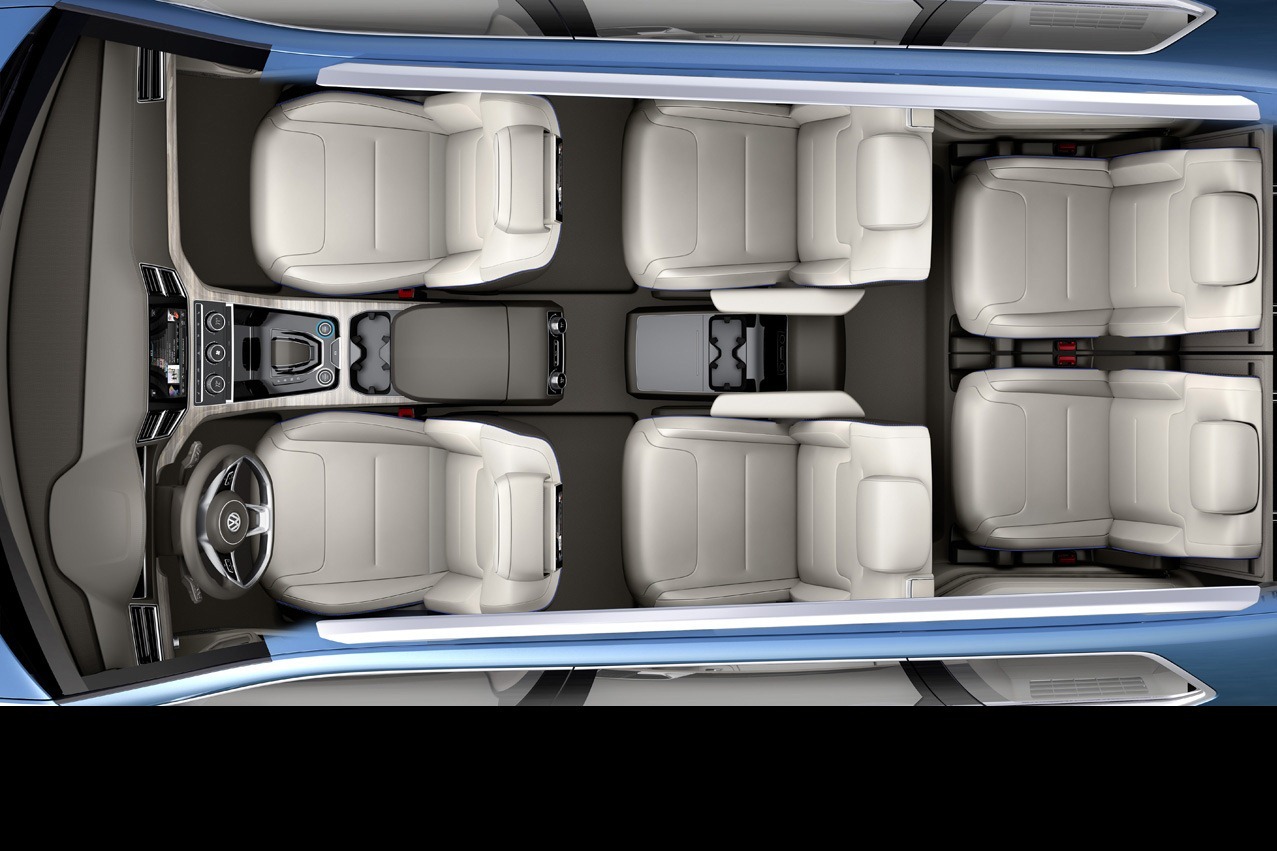
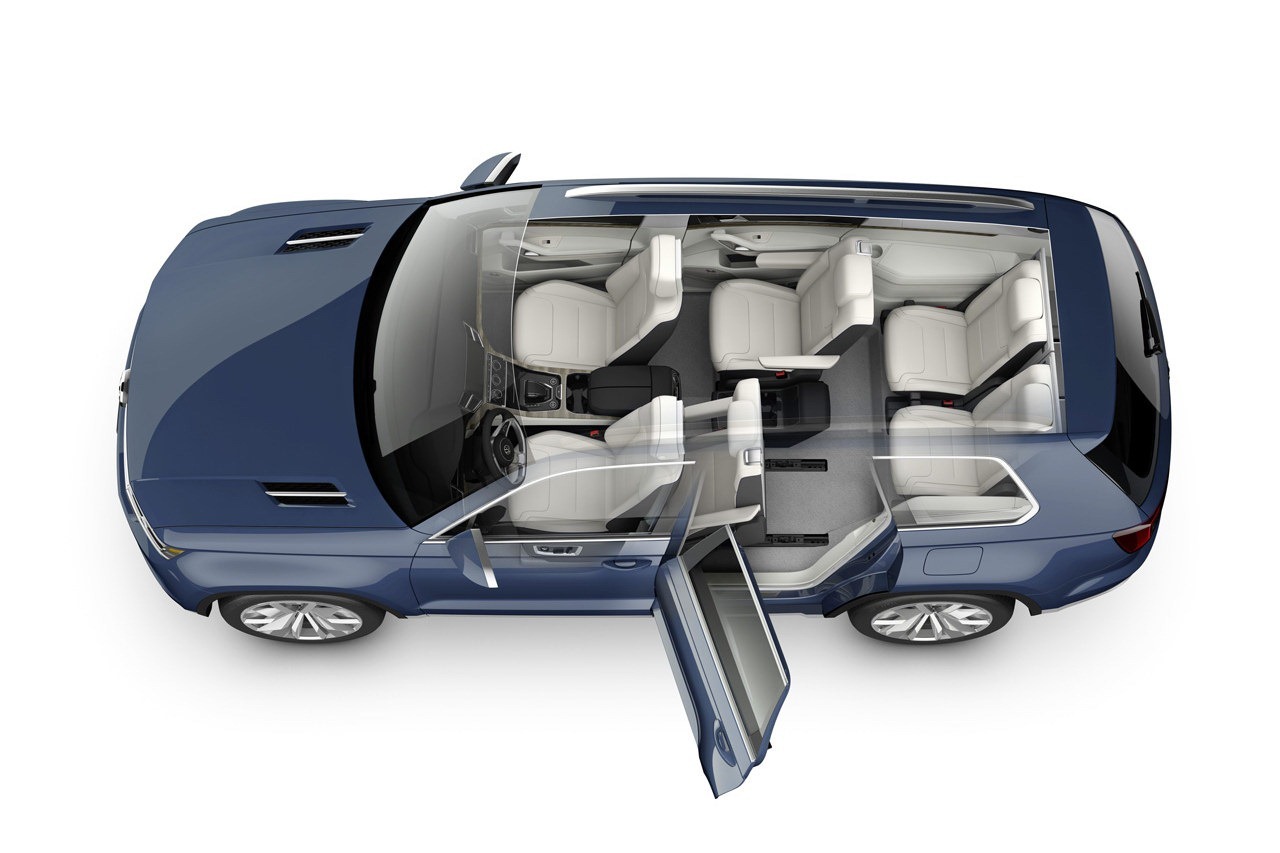
The CrossBlue concept, which boasts six individual seats, combines the visual impact of an SUV with the spaciousness and flexibility of a minivan. With a comfortable highway ride, good all-around visibility, and a full raft of safety features that includes up to 12 airbags, the concept car is a spacious and safe cruiser.
The CrossBlue was designed in Germany under the leadership of Walter de Silva (Head of Design, Volkswagen Group) and Klaus Bischoff (Head of Design, Volkswagen Brand), in close coordination with Volkswagen of America. The vehicle merges the clean lines of German Volkswagen design DNA with the masculine character of an American SUV. This results in a very realistic vehicle that eschews showcar gaudiness to give a glimpse at a potential new Volkswagen SUV.
"The CrossBlue concept is exactly the right type of vehicle for the U.S. market," said Jonathan Browning, President and CEO, Volkswagen Group of America. "It combines a truly versatile interior layout with sophisticated Volkswagen design, to give a unique and supremely stylish offering in this segment. Moreover, the vehicle showcases our innovative German powertrain engineering and the bandwidth of the new MQB architecture."
A Volkswagen Made for America
Painted in "CrossBlue Glass Flake", the concept is 196.3 inches long, 79.3 inches wide, and 68.2 inches high. It assumes a very confident stance on the road thanks to wide front and rear tracks of 66.4 and 66.8 inches respectively, 21-inch aluminum-alloy wheels shod with 235/45 tires, and significantly flared wheelarches.
Painted in "CrossBlue Glass Flake", the concept is 196.3 inches long, 79.3 inches wide, and 68.2 inches high. It assumes a very confident stance on the road thanks to wide front and rear tracks of 66.4 and 66.8 inches respectively, 21-inch aluminum-alloy wheels shod with 235/45 tires, and significantly flared wheelarches.
Contrasting with the body color is stainless-steel trim that runs all around the SUV's lower body section. Developed by a team led by Marc Lichte (Senior Designer, Volkswagen Brand), the CrossBlue features a very prominent and long hood that integrates the engine's air intakes, a roofline that is also long, and a very short frontal overhang. The vehicle's silhouette ascends slightly towards the rear, a visual impression that's reinforced by a widening character line that runs from the headlights back to the taillights. Typically for a Volkswagen, there's a precisely styled line above this.
The CrossBlue is equipped with two "fuel doors"-the filler neck for the diesel tank is on the passenger side, and engineers integrated two electrical sockets behind the door on the driver's side. The first socket is used to charge the lithium-ion battery and the second can be used to connect electrical devices such as coolers or camping lights. In this case, the CrossBlue acts as an auxiliary electrical generator.
A key element of Volkswagen design DNA is the predominance of horizontal lines at the front and rear of the vehicle. The Volkswagen design team has further developed this in the CrossBlue. The radiator grille trim, consisting of two solid aluminum struts and a centrally positioned VW logo, is now a three-dimensional element that extends into the headlights and defines the entire front end. The upper aluminum strut frames the dual headlights, while the lower strut transitions into a line that extends across the entire front end and visually lengthens the grille. This gives the CrossBlue the appearance of being wider than it actually is.
The Volkswagen designers attended to even the smallest of details with great care. The air intakes in the bumper are an example. They are trimmed by horizontally mounted, black-painted pieces that are actually three-dimensional honeycomb structures when you examine them closely. Beneath the bumper, the front end is finished by stainless-steel-style trim and integrated underbody protection.
As at the front end, the designers accentuated the sculpted LED taillights with aluminum elements as well. From a styling perspective, the taillights are designed in the form of an "E" that opens towards the vehicle centerline. In the inner area, the contours of these two "Es" are trimmed in aluminum. The prominent tailpipes have a stainless-steel look and are integrated in a trim panel that features underbody protection.
Ample Space and Maximum Comfort
The interior is a key part of any crossover utility vehicle and the CrossBlue's is ultra-stylish, luxurious, and versatile. The team headed by Tomasz Bachorsky (Lead Designer, Volkswagen Brand) equipped the concept car with six individual seats in three rows. In a production version, the second row would have the option of three seats to make it a full seven seater. Although the third row features stadium-style seating, which children will appreciate, headroom is excellent throughout the vehicle: 42.4 inches up front, 40.2 inches in the middle, and 37.6 inches in the rear. Legroom is ample, too, with 37.3 inches in the second row and 36.1 inches in the third row. Convenient access to the rear seats is assured by sliding second-row seats that can be managed with a single hand movement.
The interior is a key part of any crossover utility vehicle and the CrossBlue's is ultra-stylish, luxurious, and versatile. The team headed by Tomasz Bachorsky (Lead Designer, Volkswagen Brand) equipped the concept car with six individual seats in three rows. In a production version, the second row would have the option of three seats to make it a full seven seater. Although the third row features stadium-style seating, which children will appreciate, headroom is excellent throughout the vehicle: 42.4 inches up front, 40.2 inches in the middle, and 37.6 inches in the rear. Legroom is ample, too, with 37.3 inches in the second row and 36.1 inches in the third row. Convenient access to the rear seats is assured by sliding second-row seats that can be managed with a single hand movement.
Behind the third seating row is a spacious cargo area. With the third row folded, load length is 48.8 inches, a figure that increases to 83.5 inches with the second row stowed. A fully folding front passenger seat means that objects up to 118 inches long can be accommodated inside the CrossBlue, perfect for the weekend run to the home improvement store.
The CrossBlue is not only an extremely spacious and comfortable SUV; it is also a very sophisticated one from the point of view of its materials and its precise styling and form language. In the process, the designers and engineers created an interior that will likely set new standards for this class.
As soon as the driver starts the SUV, the round-shaped controls for the lights, climate control, and the four-wheel-drive system emerge from their flush resting positions. The controls have rugged aluminum surrounds: aluminum is one of the predominant materials in the interior and is used for the air vent surrounds and the array of switches as well as for such features as the steering wheel spokes.
Leather and wood are also used to finish the interior. Oona Scheepers, Head of Color & Trim, decided to use especially distinctive dark stained banana tree wood accents. The lines of these wood accents "flow" from the sporty gearshift area and ascend the center console and across the lower instrument panel to the door trim, playing a large role in defining the interior space in the front of the vehicle. Above these wood accents and around the two-part center armrest, dark "Marble Gray" leather is used, with light beige "St Tropez" leather, trim pieces, and fabrics used beneath the wood accents and on the seats.
Contemporary technologies are integrated with these refined materials to make a clear design statement. Positioned centrally on the center console is a 10.2-inch touchscreen that is framed by an aluminum surround and central air vents. The large touchscreen is not only used to control all infotainment functions, but also to access the status of the hybrid system. Another new feature is a 3D display of either the navigation route or the contents of the media center. All the important switches in the passenger compartment-except for the hazard flasher switch-are soft-touch components that have a similar feel to using a touchscreen.
The instruments are also high-tech. The instrument cluster is designed to be user programmable, offering a wide variety of functions and displays. For example, the CrossBlue can be driven in different powertrain modes: information related to the "Eco" mode is shown with a blue background, while the "Sport" setting is shown in red.
The instruments are also high-tech. The instrument cluster is designed to be user programmable, offering a wide variety of functions and displays. For example, the CrossBlue can be driven in different powertrain modes: information related to the "Eco" mode is shown with a blue background, while the "Sport" setting is shown in red.
The on-board entertainment system is as cool as it gets. To ensure that second- and third-row passengers can fully enjoy audio, video, and online entertainment, iPad® mini devices are integrated as monitors in the front-row head restraints. A Fender® Premium Audio System ensures concert-hall-quality sound throughout the vehicle. Second- and third-row occupants also have full control over the climate-control system in their part of the vehicle.
Drivetrain Combines Efficiency and Fun
The CrossBlue is based on Volkswagen's new Modular Transverse Matrix (MQB) components set. This vehicle brings together MQB elements that could underpin a future generation of SUVs, such as the front and rear suspensions, the 190-horsepower TDI Clean Diesel engine from the new EA288 family, and a six-speed DSG dual-clutch automatic transmission. These components are combined with electrical parts that are also "made by Volkswagen," such as the lithium-ion battery in the center tunnel and the 54-hp front and 114-hp rear electric motors. The Cross Coupé compact SUV concept-also being shown for the first time in the U.S. in Detroit-uses a similar powertrain concept, showing the extent of the MQB's modularity.
The CrossBlue is based on Volkswagen's new Modular Transverse Matrix (MQB) components set. This vehicle brings together MQB elements that could underpin a future generation of SUVs, such as the front and rear suspensions, the 190-horsepower TDI Clean Diesel engine from the new EA288 family, and a six-speed DSG dual-clutch automatic transmission. These components are combined with electrical parts that are also "made by Volkswagen," such as the lithium-ion battery in the center tunnel and the 54-hp front and 114-hp rear electric motors. The Cross Coupé compact SUV concept-also being shown for the first time in the U.S. in Detroit-uses a similar powertrain concept, showing the extent of the MQB's modularity.
The CrossBlue is as efficient as it is sporty. As already noted, Volkswagen estimates 89 mpge in electric mode and 35 mpg combined running as a hybrid, as well as a 0 to 60 mph time of 7.2 seconds. Although the combined power output of 305 hp is impressive, the torque characteristics are amazing. The TDI Clean Diesel engine makes 295 lb-ft from just 1750 rpm, while the electric motors produce their torque-133 lb-ft at the front wheels and 199 lb-ft at the rear-immediately. Combined, the system can produce up to 516 lb-ft, a stout number.
Different Operating Modes: The CrossBlue's default mode is as a classic hybrid. The electric motor is used for propulsive power as often as possible in this situation. The driver can also switch to "Eco" or "Sport" modes by pressing a button to the right of the shift lever. In Eco mode, parameters such as the throttle map and air conditioning are controlled for minimal fuel and electrical consumption. In Sport mode, the drive system's maximum power potential is exploited. Other available modes are: offroad, where all-wheel-drive is permanently engaged; charging; and EV mode, where it drives as an electric vehicle.
Powered by its lithium-ion battery, the CrossBlue can cover a distance of up to 14 miles as an EV, although top speed is reduced from 127 mph to 75 mph. In E-mode, only the 114-hp rear electric motor propels the vehicle and the TDI engine is shut off and decoupled from the drivetrain. Even at speeds of up to 75 mph, the internal combustion engine is not engaged as long as the battery has sufficient charge. As soon as there is a need for TDI power, it is coupled to the drivetrain again, jolt-free, within fractions of a second.
The CrossBlue's lithium-ion battery has an energy capacity of 9.8 kWh and is housed in the center tunnel. The power electronics unit integrated in the engine compartment operates at a level of around 370V and manages the flow of high-voltage energy to and from the battery and the electric motors. A DC/DC converter supplies the vehicle's electrical system with the 12-volt power it needs. The battery can be charged either by external power sources or by the TDI engine while the vehicle is in motion.
The driver can intentionally switch over to a charging mode by pressing another button on the center console. The TDI engine charges the battery while driving in order to store enough electrical energy for EV operation later in the journey-for instance, in an urban area.
There are also a number of other specific modes that automatically come into play, depending on the circumstances.
There are also a number of other specific modes that automatically come into play, depending on the circumstances.
Coasting: As soon as the driver releases the accelerator pedal, the engine and electric motors are decoupled from the drivetrain and the engine is shut off, provided that the battery is sufficiently charged. This is referred to as "coasting." No emissions are generated.
Battery regeneration: Whenever the driver releases the accelerator pedal or applies the brakes, and the battery is insufficiently charged, the two electric motors act as generators and feed energy recovered from the brakes into the lithium-ion battery. In this case, the TDI engine is also shut off and decoupled from the drivetrain to ensure maximum regeneration.
Boosting: When very sporty performance is required, the electric motors form an alliance with the TDI engine known as "boosting": in this mode, all four wheels are driven.
Boosting: When very sporty performance is required, the electric motors form an alliance with the TDI engine known as "boosting": in this mode, all four wheels are driven.
Offroad ("propshaft by wire"): All four wheels are also driven whenever offroad mode is intentionally activated. In this case, however, the front electric motor-which is now supplied with energy by the TDI engine-operates exclusively as a generator and a power source for the electric motor at the rear. Since the energy for driving the rear wheels is electrical rather than mechanical, this is referred to as "propshaft by wire". Because the TDI engine drives the front wheels in off¬road mode, the four-wheel-drive system is still operational even when the battery doesn't have much charge.
TDI only: When the TDI engine is the sole source for propulsive power, the CrossBlue is a pure front-wheel-drive vehicle. Thanks to the efficient turbocharged, common-rail, direct fuel-injection diesel engine, the concept car is still very fuel-efficient. Based on manufacturer estimates, the CrossBlue would attain 37 mpg highway and 33 mpg city, values that a gasoline-engined SUV would find hard to match.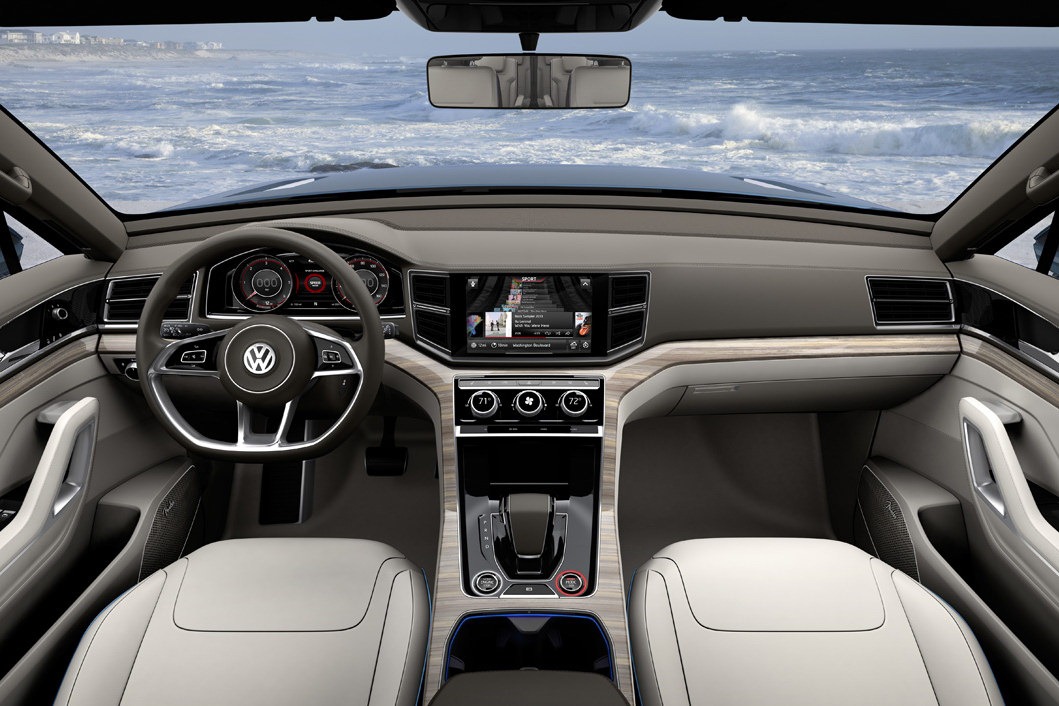
Comments
Post a Comment