1996 Buick Roadmaster Estate Wagon Interior

EU, Fuel Labels

Today, a new harmonised set of fuel labels will appear across Europe. They will give drivers better information on the suitability of fuels for their vehicles wherever they travel in the EU, helping them avoid misfuelling and informing on the environmental impact of their choice.

Alternative fuels can help reduce Europe's air quality problems, much of which are caused by transport emissions. However, the growing diversity of fuels available on the European market means that drivers, businesses and fuel station operators need clearer information on fuels sold at filling stations From now on, when customers arrive at a public filling station of any Member State, they will notice new EU-wide harmonized fuel symbols on fuel dispensers and fuel nozzles. The same harmonised, easy-to-read, clear and simple labels will also be compulsory for newly produced vehicles and will be shown on the fuel-filler caps. These new labels do not replace existing names and brands of fuels, nor quality, safety, and performance recommendations. The labels are based on industry standards and have been developed by European standardisation bodies with the participation of industry, consumer and civic society representatives.

This initiative is taken on the basis of Article 7 of the Alternative fuels infrastructure Directive of October 2014 and is in line with the Commission's Action Plan on Alternative Fuels Infrastructure, adopted in November 2017, which sets out a number of support actions to accelerate the roll out of infrastructure, increase investments and improve consumer acceptance. It also complements the Juncker Commission's proposals "Europe on the Move" for a clean, safe and connected mobility. 

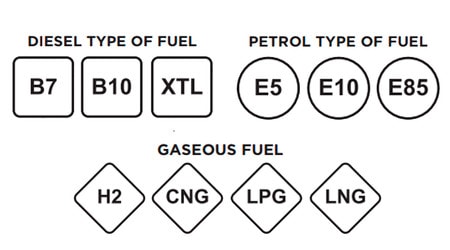
The new labels are divided in to three groups: 

Gasoline-type fuels: marked by an “E” inside a circle: E5, E10, etc (“E” stands for specific bio-components (ethanol) present in petrol);
gasoline type fuels

Diesel-type fuels: marked by a “B” inside a square: B7, B10, XTL, etc (“B” stands for specific biodiesel components present in diesel, the XTL stands for synthetic diesel and indicates that it is not derived from crude oil);
diesel type fuels

Gaseous-type fuels, mentioning their specific subtype within a rhombus/diamond: e.g. CNG, LNG, LPG and H2 (hydrogen);
gaseous type fuels

In the case of newer vehicles, the labels will also be visible in the owner's manual and they may also appear in the electronic handbook available via a vehicle's infotainment center. Besides being visible in all public refueling stations, they should also be visible at vehicle dealerships. The new labels will be deployed in all 28 European Union member states, EEA countries (Iceland, Lichtenstein and Norway), and also Macedonia, Serbia, Switzerland and Turkey. 

Background

Today, transport still relies on oil for a large part of its energy needs. Energy efficiency in transport and effective transport management can substantially contribute to reduce emissions and oil consumption. One way of doing so is investing in alternative fuel solutions, which can help decarbonise transport by gradually substituting the fossil energy sources which are responsible for the CO2 emissions from transport. Research and technological development have led to successful demonstrations of alternative fuel solutions for all transport modes. Market take-up, however, requires additional policy action. To solve this issue, in 2014, as part of the Clean Power for Transport strategy, Directive 2014/94/EU on the deployment of alternative fuels infrastructure was adopted, aiming to facilitate the development of a single market for alternative fuels for transport in Europe.

The Directive also called for a way for setting up appropriate consumer information on fuels, including a clear and sound indication of the compatibility between different fuels and cars. The call for better consumer information arose from the multiplicity of fuel choices becoming available on the market, in particular with the roll-out of new alternative fuels.

In view of this increasing choice of fuels facing consumers, the Directive mandated the European Committee for Standardization (CEN) to come up with industry-wide standards that would improve existing information. CEN adopted on 12 October 2016 standard EN 16942, "Fuels-Identification of vehicle compatibility-Graphical expression for consumer information", which enters into force 2 years later, on 12 October 2018. A new standard “EN 17186:2019” laying down harmonized identifiers for power supply for electric road vehicles is expected to be adopted early 2019.

In May 2018, the Commission also adopted an Implementing Regulation on Fuel Price Comparison which establishes a common methodology to facilitate the comparison of prices of the different fuels in a common unit (euro/ national currency) taking into account the energy content of the fuel and the energy efficiency of the vehicle.

Comments

Popular posts from this blog

Cute girl drifting in rally car unfastened

The 9th Dream Car from the Top 10: GM-X Stiletto

When we think of dream cars, our minds often race to sleek designs, innovative technology, and that unmistakable feeling of pure, unbridled passion. The GM-X Stiletto encapsulates all of these elements and more, making it a worthy contender in our top ten list. Ranked at number nine, this concept car from 1964 remains a beacon of automotive ingenuity and a symbol of a bygone era that continues to inspire. A Journey Back to the Jet Age To fully appreciate the GM-X Stiletto, we must travel back to the 1950s and '60s, a time when America was captivated by the future. The jet-age was in full swing, and cars were designed with a sense of bold optimism. Under the visionary leadership of Harley Earl and Bill Mitchell, General Motors created vehicles that mimicked the sleek lines and advanced technologies of jet aircraft. The GM-X Stiletto, born in 1964, was a product of this era's boundless imagination. The Visionary Design The GM-X Stiletto was first unveiled at the 1964-1965 World’s...

【中継】日産モータースポーツファンイベント

10 Newest Cars and SUVs by South Korean Manufacturers (2025-2026 Lineup ...

The 1000 km range Cupra SUV! Cupra Tindaya REVEAL

Bass And Boobs + Skirt Trick & Can Trick

Aventador S | The design draws inspiration from predators and aeronautics

As much as the Aventador is the car most entitled to represent the Lamborghini brand values, the Aventador S is the expression of the Lamborghini flagship par excellence, embodying the utmost synergy between design and engineering in pure Lamborghini style. The “S” has existed for 50 years The first Lamborghini S model was launched 50 years ago to represent the evolution of already revered icons. In fact, the further development of the Miura into a more improved version dates back to 1968, followed by Islero, Countach and Urraco. When the Aventador reaped this legacy and decided to surpass itself, the Aventador S was born. The design draws inspiration from predators and aeronautics The Aventador S presents pure refinement of the iconic design that remains true to the Lamborghini DNA, enhancing its mix of dynamism, refinement and aggressiveness. The sharp lines and surfaces of the front end evoke images of a shark fin, transmitting the same force and elegance when d...

1985 Audi Sport Quattro: The Group B Homologation Special

In Austria in 1980, just a year after four-wheel drive cars became eligible to compete in the WRC, Audi debuted the first Quattro rally car and forever changed the sport. Over the next half of the decade (and onwards, if you count the Pikes Peak specials), these Audis would be subjected to a period of rapid iterative evolution that led to the short-wheelbase Sport Quattro models that helped define the infamously fast and dangerous era of Group B rallying. The relatively lax nature of the Group B regulations gave rise to a number of downright ferocious cars from Audi’s competitors (most notable being Lancia and Peugeot), and while it was not the most successful nor technologically advanced of these top tier cars by the end of the Group B era, the Sport Quattro is a worthy poster child for the lot of them—being first to the punch has its advantages. The advent of the Group B class provided manufacturers with practically every leeway imaginable given they adhered to a basic s...

Chevrolet Concept Cars: Ten Of Our Favorites

Most celebrations of Chevrolet's centennial surround the automaker's production vehicles. Why not? After all, this is the brand that birthed legends like the Bel Air, Corvette, and Camaro, among others. Those vehicles are certainly worth celebrating, but we can't help but wonder: what about the Chevrolet cars that never saw a production line? We've scoured through the history books (and our memory banks) to pick out ten of our all-time favorites.

INFINITI QX50: A luxury crossover with world-first technologies and an all-new platform

NASHVILLE, Tenn. –  The new 2019 QX50 is the most compelling INFINITI to date. Based on an entirely new platform, the new QX50 is a mid-size crossover with world-first technologies, standout design and unrivaled interior space. " The 2019 QX50 is the most important vehicle we have ever launched, and it embodies everything the brand stands for: beautiful design, advanced technology and empowering performance.  As a luxury, mid-size crossover, it's the right vehicle at the right time in one of the world's fastest growing segments." Christian Meunier, INFINITI Global Division Vice President VC-Turbo – the world's first production-ready variable compression ratio engine The VC-Turbo engine is the world's first production-ready variable compression ratio engine, transforming on demand. A breakthrough in combustion engine design, the 2.0-liter VC-Turbo engine adjusts its compression ratio to optimize power and efficiency. It combines the power of a 2...

Labels

Show more