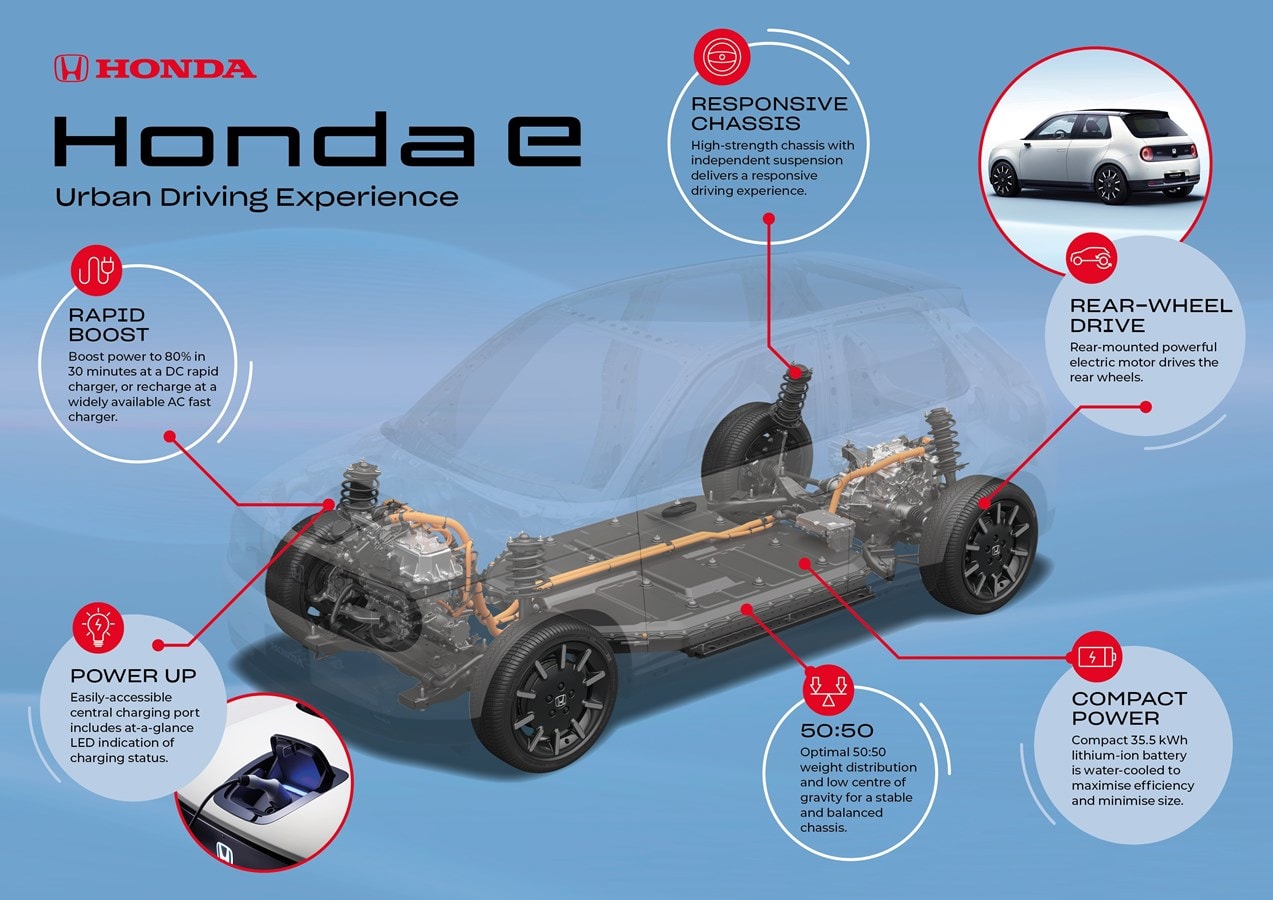
Honda's new compact electric vehicle, the Honda e, is the first Honda to be built on a dedicated EV platform, designed from the ground up to deliver excellent Honda driving dynamics.
The Honda e platform has been developed focussing on urban environments to offer a rewarding, responsive driving experience. The battery is positioned at a low level under the floor, and centrally within the wheelbase of the car, affording a 50:50 weight distribution and low centre of gravity for optimal handling and stability. Power from the high-torque electric motor is delivered through the rear wheels, enabling steering precision even at high acceleration.
The platform offers a combination of ride comfort and agility. The four-wheel independent suspension is engineered to offer outstanding stability in all conditions, a smooth ride and responsive handling. Elements of the suspension components are forged aluminium to reduce weight and benefit performance and efficiency.
When combined with its compact size and short overhang, the Honda e delivers next-generation small car agility to make city driving enjoyable and tight manoeuvres in urban environments effortless.
For continued ease of use and charging flexibility, the reliable 35.5 kWh Lithium-ion high-capacity battery, can be charged using either Type 2 AC connection or a CCS2 DC rapid charger. Combined with a full range of over 200Km, the fast-charge capability of the advanced powertrain will deliver exceptional usability to meet the demands of everyday commuting providing 80% charge in 30 minutes.
Designed with a focus on simplicity and usability, the Honda e charging port is integrated into the bonnet, with LED lighting visible through a glass panel to illuminate the port for the driver and highlight the battery charging status. The positioning of the charging port allows easy access from the front of the car or from either side. Displays on the dual touchscreens inside the car present the current level of battery charge, while a drivetrain graphic charts the current power flow and the regeneration and recharging status.
The battery pack is water-cooled to maintain an optimum thermal state therefore maximising the efficiency of the battery and charge state, while also ensuring its size and weight are minimised so that it does not compromise cabin room.
Honda’s new compact electric car is a key part of the brand’s latest electrification commitment to feature electrified technology in 100% of its European sales by 2025. Presented in prototype form at the 2019 Geneva Motor Show, the first Honda production battery electric vehicle for the European market will make its mass production debut later this year.
Honda has already received 31,000 expressions of interest, and customers can make a reservation for priority ordering online in UK, Germany, France and Norway or register their interest in other European markets on the Honda national websites.
Comments
Post a Comment